


If your Shopee cross-border store shows these three signals at the same time: "waiting too long" starts appearing in the comment section of the same product; you want to sign up for a sitewide major sale, but the backend entry is grayed out; the previous batch just sold out, but the wallet balance is still on the way, and you have to front the restocking payment from somewhere else—then whether to open a local store is not about "opening one more store," but about whether the entire operational chain needs to be replaced.
When two or more of these signals appear, a local store is worth seriously running the numbers on. Below, we won't explain what a cross-border store is or what a local store is; instead, we'll break it down item by item across nine operational differences: materials, permissions, traffic, fulfillment, funds, advertising, after-sales, compliance, and multi-store environment.
The first difference: registration materials and store opening path—how to register a local store and what materials to prepare
The real dividing line between local stores and cross-border stores lies in the entity: cross-border stores use a Chinese business license to go through the cross-border seller channel; local stores require the registered entity, payment-receiving entity, and shipping location—all three—to be in the same site country. This is also why there is no uniform answer to 'Shopee local store materials'—different sites and different store types have different checklists.
For common sites such as Thailand, Vietnam, and Malaysia, these types of materials are usually required (ultimately subject to the requirements on each site's Seller Center onboarding page):
- Local entity documents.Locally registered company documents, or local personal identification permitted by the site. If the entity is chosen incorrectly, the address and payment collection will both need to be redone.
- Identity proof of the person in charge.It must match the legal representative or operator shown on the entity documents, and the name spelling must align exactly with the bank account used later.
- Local proof of address.Recent utility bills, lease contracts, or bank statements; the name must match the entity. If you use someone else's address, you will usually be required to provide additional authorization.
- Local receiving account.A local bank account or a local receiving account supported by the platform; the account name must match the registered entity.
- Local phone number and email.Used to receive verification codes and review notifications; overseas numbers tend to get stuck at the verification step.
- Category qualifications.Categories such as beauty, food, health supplements, and 3C require local certification or import documents; if even one is missing, you cannot list the product.
It is recommended to fix the registration sequence into one line: first decide the entity and legal representative → open a local receiving account → prepare complete proof of address → submit the onboarding application → after approval, first use a small order to run through the entire chain of "order placement—shipping—receipt—payment collection", then scale up. The most common blockers are three "inconsistencies": proof of address inconsistent with the entity, bank account name inconsistent with the store entity, and the same entity opening duplicate stores on the same site triggering a secondary review. For the logic used to determine quantity and entity duplication, you can first look at How many local stores can one business license open?, then decide how many entities to use to open stores.
Difference Two: Backend permissions and category access—what can and cannot be sold
The backends may all be called Seller Center, but the buttons you can click are different. The differences are concentrated in these areas:
| Operations dimension | Cross-border store | Local store | What this means for operations |
|---|---|---|---|
| Category access | The range of open categories is relatively narrow, and sensitive products are restricted | More categories are available, and most common local categories can generally be listed | For categories such as beauty, food, and maternal and infant products, local stores are the main entry point |
| Brand and IP authorization | The review process is lengthy and requires additional authorization materials. | Submit authorization according to local rules; some sites have shorter processes. | For brand distribution, confirm the authorization chain before choosing a store type. |
| Platform campaign registration | For most sites, major promotions are scheduled separately by the cross-border team. | Eligible to register for local major promotions, local free shipping, and flash sales. | Local stores usually have more frequent campaign registration windows. |
| Store decoration and content modules | Templates and modules are relatively fixed. | More localization modules are available. | Teams that drive local content conversion are more likely to pull ahead. |
| Payment methods | Mainly rely on cross-border payment collection methods supported by the platform. | Can integrate mainstream local payment methods and cash on delivery. | In markets with a high proportion of cash on delivery, local stores have a greater conversion advantage. |
The criteria for product selection are simple: for categories that are heavy, time-sensitive, require local certification, and rely on cash on delivery, prioritize local stores; for lightweight small items, high SKU counts, and products still in the testing phase, cross-border stores are more convenient, and only after a hit product emerges should you consider local stocking.
Difference three: traffic distribution and search weight—local stores do not automatically generate a surge in orders.
Treating local stores as a traffic shortcut is the most common misjudgment. Their traffic advantage comes from several variables that the platform can calculate: local shipping origin, short delivery confirmation time, fast return processing, eligibility for local campaigns, and support for local payments. These raise conversion rates and fulfillment performance, and performance in turn affects exposure allocation. It is not 'open one and get preferential treatment,' but 'only when the operational chain runs smoothly do you get preferential treatment.'
Cross-border stores also hold their own entry points: overseas warehouse shipping can shorten delivery times, official cross-border campaigns have independent resource slots, and ad placement is not restricted by store type. The judgment criterion is straightforward: if the problem is conversion (price, detail page, reviews), switching to a local store will not automatically solve it; if the problem is delivery time and access to local campaigns, then a local store is meaningful.
Difference four: logistics fulfillment and shipping timeliness—the chain from order generation to delivery confirmation.
The cross-border store chain is: order generated → packed at domestic warehouse → cross-border shipping label → handed to platform pickup or first-leg logistics → customs clearance → delivery in destination country → delivery confirmation. Customs clearance and destination-country delivery are the two hardest segments to control, and the 'waiting' buyers' experience is mainly spent here. The local store chain is shorter: order generated → packed at local warehouse → local shipping label → local courier pickup → delivery confirmation, with delivery time usually measured in days.
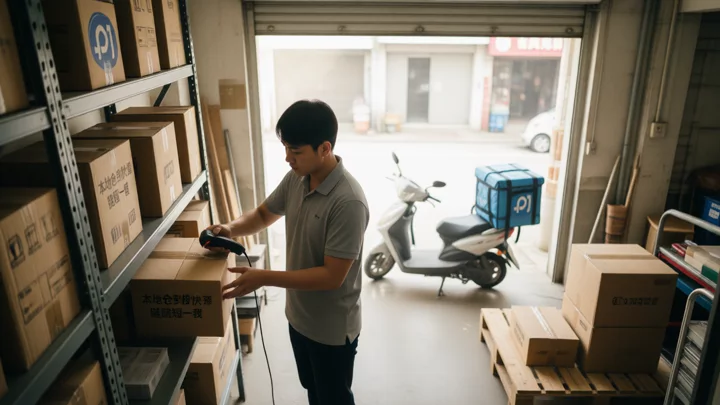
The cost of the shorter chain is committing goods and money locally in advance. There are generally three ways to stock inventory: own local warehouse, third-party overseas warehouse, and platform official warehouse; last-mile delivery can use mainstream local couriers or the platform's local logistics. Which one to choose depends on category gross margin and sales velocity: fast-selling, small-volume products are suitable for local stocking, while stocking long-tail SKUs locally is a capital black hole.
- Delivery time boundary:Local warehouse shipping can deliver within a few business days on most marketplaces, while cross-border direct shipping is usually measured in weeks.
- Cost boundary:Local last-mile unit costs are low, but first-leg consolidation, warehousing fees, and slow-moving inventory disposal fees must be calculated together; looking only at shipping costs will underestimate the cost of a local store.
- Risk boundary:Stockpiling means both inventory and capital are tied up at the same time; getting one product running first before expanding warehousing is more stable than laying out ten SKUs at once.
Difference Five: Commission, Payment Fee Rates, and Payout Cycle—When Does the Money Arrive?
The fee structures on both sides include platform commissions and payment processing fees, but the calculation basis differs: cross-border stores are deducted according to cross-border settlement rules, while local stores are deducted according to local rules; some marketplaces also have phased policies for local stores. What really creates the gap is not the few percentage points of commission, but the payout cycle and the way capital is tied up.
Payouts for cross-border stores must go through cross-border collection channels before being withdrawn to the home country, resulting in a long chain and slow arrival; for local stores, the payment goes into a local account, and settlement is closer to the local rhythm, provided you have a local receiving account whose account name matches the entity. For teams with fast capital turnover, a slightly shorter payment term means a more stable replenishment rhythm.

The easiest pitfall here is “register the store first, then think about collecting payments”: only after passing review do you discover that a local account cannot be opened or the account name does not match, while the goods are already stuck in a local warehouse. For a comparison of capital and operating costs, see Breaking Down the Cost Structures of Cross-Border Stores and Local Stores the layered logic, applying each item to your own category.
Difference Six: Advertising and Marketing Tools — Available Features and Ad Ownership
Both sides have advertising tools; the difference lies in ownership and scope of availability:
- The entity linked to the advertising account differs: cross-border stores use cross-border advertising settlement, while local stores use local entity settlement; budgets and invoice entities must be managed separately.
- Coupons, free shipping campaigns, and affiliate marketing have different scopes of availability, and local stores can usually participate in more localized marketing placements.
- Livestreams and short-video shopping carts have different levels of localization, and collaborating with local creators is easier to make work within the local store system.
- When budgets are limited, put ad spend on the side where conversions are already proven, rather than opening a store just for the sake of opening one; in the early stage, local stores are better suited to testing local creative with a small budget.
Difference Seven: Customer Service, After-Sales, and Returns Processing—Where Localization Costs Hide
The return address is the dividing line. Returns for cross-border stores mostly go through cross-border or designated addresses, with long processes and a poor buyer experience; local stores need a local address that can receive goods, so returns can be handled locally and resold.
The most easily underestimated factor is not return logistics fees, but people: local store customer service must cover the local language and local time zone, and dispute evidence must be prepared according to local customs. Using domestic customer service part-timers to cover a local store usually leads to problems with response speed and dispute rates.
Difference Eight: Compliance, Tax, and Identity Verification—Which Materials Trigger a Secondary Review
After passing review and entering operations, the platform will still perform verification at several points. Most rejections are not due to bad luck, but because the materials do not match up:
- Entity consistency:Inconsistency among the names of the registered entity, legal representative, and receiving account is the most common reason for rejection.
- Address authenticity:Expired proof of address, mismatch with the registered address, or inability to provide authorization documents.
- Tax registration:Some sites require a local tax ID or tax registration documents; missing documents will cause you to be stuck at the settlement stage.
- Opening duplicate stores:Opening multiple stores on the same site under the same entity can easily trigger a duplicate-entity determination.
- Category qualifications:Certification documents do not match the product or store entity.
Follow the correction order of Entity → Account → Address → Category: first unify the entity and legal representative name across all documents, then handle the receiving account, and finally supplement the address and category qualifications. Change one item at a time to avoid being flagged for a new inconsistency after the change.
Difference Nine: Multi-store environments, account isolation, and team operations—a local store matrix cannot share a single environment
When multiple local stores and cross-border stores are operated together, the problem is often not the number of stores, but that the three variables of environment, account, and responsible person are shared: switching between backends in the same browser, logging in to multiple stores through the same network egress, sharing one main account across the whole team, and leaving no audit trail for operations; when a problem occurs, you cannot find out who did what in which environment.
- Separate environments by store:Each store has its own independent browser environment and network egress; local stores and cross-border stores are not mixed.
- Tighten sub-account permissions:Authorize by role instead of giving out the main account; keep customer service, advertising, and finance separate.
- Keep the payment collection entity and the advertising entity separate:The funds and budgets of local entities and cross-border entities are not accounted for in the same account.
- Maintain an audit trail for operations:Internally, the team must be able to check who can log in to which store and when they logged in.
- Set up handover rules:When personnel changes occur, revoke permissions according to 'Account—Environment—Owner' rather than just changing the password once.
The complete approach to the matrix—isolation order, grouping, and sub-account configuration—is detailed in Shopee Local Store Matrix Account Isolation and Compliant Operations step by step; for how the division of labor aligns with login boundaries, refer to Multi-Store Division of Labor and Login Boundaries for its division approach. When multiple stores share one computer, separate each store's browser environment first; this is easier than repeatedly changing IPs.
When there are many stores, the environment is more likely to cause problems than passwords. P1Browser supports one independent browser environment per store, and configuration and backup can begin with the Download page to get started.
Frequently Asked Questions
Without a local company or long-term visa, can I start with a Shopee local store?
Most sites require a local entity or local identity documents. Using someone else's entity means tying payment collection, address, and legal liability to another person's name, and you will not be able to handle subsequent verification yourself. A more reliable path is to first use a cross-border store to validate product selection and conversion, while preparing an entity through compliant means, and then open a local store.
Is traffic for local stores always higher than for cross-border stores?
Not necessarily. Exposure allocation depends on overall fulfillment and conversion performance; shipping origin and timeliness are only part of it, and product selection, price, reviews, and advertising will all affect the results. If you treat it as an automatic boost, you will usually be disappointed.
If I ship from a third-party warehouse, how is timeliness calculated, and does it still count as a local store?
As long as the shipping origin, waybill, and last-mile delivery follow the local chain, fulfillment is calculated according to local timeliness. The key is the accuracy of the warehouse's inventory synchronization; inaccurate inventory that leads to fake shipments or delays will directly drag down store performance.
If local stores and cross-border stores are operated together, should the environments be completely separated?
Yes. At a minimum, use one independent browser environment and independent network exit per store, account separately for payment collection and advertising entities, and authorize sub-accounts by store. A shared environment will leave operational traces across stores, making it difficult to pinpoint problems when they arise, and it may also be identified by the platform as an association signal—for specific determinations, refer to account notifications and platform policies.

