


One team had 2 TikTok Shop cross-border stores running smoothly in Thailand and decided to open 3 local stores in Thailand using the same Chinese business license. The first 2 passed review without issue, but the 3rd was rejected in the second-round review, with the reason field stating "the legal entity does not match the payout account holder." Simply "copy-pasting" cross-border store documents into the local store workflow hit a wall at store #3—the two are fundamentally built on different logic in terms of registration entity, compliance boundaries, and capital flow.
The following section walks through this chain: registration qualification differences → multi-store quantity per country → local store document checklists → second-round review rejection troubleshooting, stringing together the decision criteria and operational details needed to get 4-6 Southeast Asia local stores running in one go.
Same business license—why can't cross-border and local stores be "copy-pasted"?
The non-interchangeability between the two is reflected in five dimensions:
- Registration entity:A cross-border store only needs a Chinese business license and a corporate bank account; a local store must use a local legal entity (a Thai limited company, a Vietnamese enterprise with an MST tax number, or a Malaysian Sdn Bhd). A Chinese license is not accepted in the review for local stores in Thailand, Vietnam, or Malaysia.
- Compliance qualifications:A local store is required to have a local tax registration number and a domestic bank account for receiving payments; a cross-border store only needs a CNY or USD corporate account, with no local tax registration required.
- Payment collection chain:Payment for local stores is deposited into local currency accounts (THB / VND / MYR), while cross-border stores use cross-border payment channels such as Payoneer and PingPong. The two payment pathways must be physically segregated; mixing them will directly trigger a second-review rejection.
- Ad account ownership:TikTok Ads account binding under Business Center ad assets. A local store requires the local legal entity as the advertiser, while a cross-border store accepts a Chinese entity; if placed under the same Business Center,roles and permissionsmust be configured separately by advertiser type to avoid compliance standard conflicts.
- Applicable platform policies:Under the 2026 new rules, SPS (Seller Performance Score) and account health scores are calculated independently per site. However, violations across multiple stores owned by the same legal entity in the same country will cross-affect the AHR scores of all stores in that country, which in turn impacts Black Friday mega-sale registration eligibility.
Multiple Stores in One Country: How Many Can You Open in Thailand, Vietnam, and Malaysia, and How Do Business License Types Map
Thailand local stores are registered under a "Thailand Co., Ltd." entity; a single Thai business license typically allows 1-3 local stores on the TikTok Shop Thailand site. Vietnam local stores require a Vietnamese business license with an MST tax number, capped at 1-3 stores per country. Malaysia uses Sdn Bhd or a business license (SSM registration), also 1-3 stores. Cross-border stores are uniformly calculated as 1-2 stores per single Chinese business license. See the full quantity limits and store cluster scale calculations inHow Many TikTok Shops Can One Business License Open.
Before expanding, there is a hard constraint: an AHR of 150 is the prerequisite threshold for Black Friday mega-sale registration. If any of the 3 local stores in a country has an SPS below 60, all stores of that legal entity in that country will be restricted from participating in mega-sales. Before opening a new store, check the account health score of existing stores to avoid "old stores getting locked before you even open a new one."
Southeast Asia Local Store Registration Document Checklist: Itemized by Country
| Document Item | Thailand | Vietnam | Malaysia | Required for Cross-Border Stores |
|---|---|---|---|---|
| Local business license | Thai Limited Company Certificate (DBD) | Vietnamese Business License + MST | Sdn Bhd / SSM Registration | No |
| Legal representative proof of identity | Passport + Thai work permit or residence permit | Passport + Vietnamese work permit | Passport + EP pass | No (use Chinese national ID) |
| Tax registration | Thai TIN + Income Tax Registration Certificate | MST Tax Number + Tax Registration | TIN + LHDN Registration | No |
| Local receiving account | THB corporate account | VND corporate account | MYR corporate account | No (use cross-border receiving) |
| Brand / Trademark | Proprietary trademark or authorization letter | Proprietary trademark or authorization letter | Proprietary trademark or authorization letter | Varies by category |
| Category-specific requirements | Food requires FDA; beauty requires THERA | Food requires VFA; beauty requires POMDS | Food requires KKM; health supplements require NPRA | Varies by category |
The 3 most frequent missing items in a "Document review failed" case: the local receiving account bank is not in the same city as the registered address on the business license; the legal representative's passport has less than 6 months of validity remaining; the brand authorization letter has not been notarized in the local language. These three items arealso noted in the cost breakdown for cross-border vs. local stores, and can be completed in advance before registration.
Second-review rejection troubleshooting: a 4-step diagnostic path from trigger point to resolution
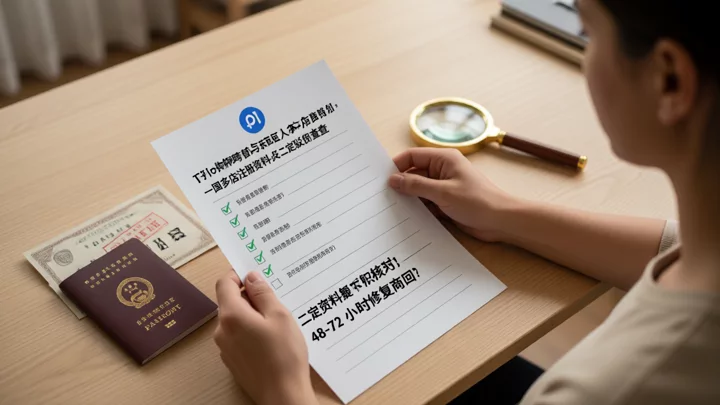
- Read the rejection notice keywords to identify the triggering layer.The backend notification will specify the reason category: "legal representative verification failed," "documents inconsistent with the payment entity," "logistics tracking missing," "brand qualification expired." Cross-reference the table above to confirm whether the issue lies in the registration entity, tax, payment, or compliance qualification layer.
- Cross-reference the triggering layer to check shared variables.Verify field by field: whether the company name on the business license exactly matches the registered name on the payment account; whether the legal representative's name matches the passport; whether any requirement to upload tracking within 72 hours in the logistics fulfillment records has been missed. In multi-store scenarios, also investigatecross-store associated variables— shared proxy IPs, shared payment accounts, and the same customer service IP logging into multiple store backends will all leave traces.
- Execute the corrective actions.Legal representative verification failed → Retake photos of the passport and the front of the business license, ensuring all four corners are fully visible with no reflections; Payment entity mismatch → Contact the local bank to update the account's registered name or switch to a different account; Logistics tracking missing → Manually enter the tracking numbers and tracking screenshots for the most recent 5 orders in the backend; Brand qualification expired → Update the authorization letter to a validity period of 12 months or more and obtain a notarized translation in the local language.
- Confirm the timing for resubmission.After making corrections, wait 48-72 hours before resubmitting to allow the platform's system cache to refresh. After the same legal representative is rejected 2 times consecutively in the same country, the 3rd submission enters the manual review queue, with the processing period extending to 5-7 business days. Before submitting, check off each item on the checklist—do not "just submit one and see what happens."
FAQ
How many stores can be opened with a single business license on TikTok Shop?
For cross-border stores, one Chinese business license typically supports 1-2 stores; for Southeast Asia local stores, a local license is required per country, covering 1-3 stores each. Exceeding 3 stores triggers an additional platform review stage — not an outright ban, but the review timeline and rejection probability increase noticeably.
How soon can I resubmit after a second-round rejection?
After correcting the documents, wait 48-72 hours before resubmitting to allow the platform's system to refresh. If the same legal entity in the same country is rejected 2 times consecutively, the 3rd submission enters the manual review queue, extending the cycle to 5-7 business days.
Can a local store's receiving account be shared with a cross-border store?
No. Local stores must use a corporate account denominated in the local currency (THB / VND / MYR), while cross-border stores go through Payoneer or PingPong. Sharing an account is the most frequent reason for second-round rejection, classified as "mismatch between the legal entity and the payment recipient."

