



A team opened 3 consecutive local shops in Thailand under the same business license. The secondary review rejection notice for the 3rd shop stated: "Legal representative document information does not match the registration entity." The operations lead checked the name spelling character by character—it was indeed consistent. What actually stalled the process were two overlooked details: the legal representative's passport had less than 12 months of remaining validity, and the 3rd shop's payment account was registered under the 2nd shop. Within 48 hours of the rejection triggering, the 1st and 2nd shops simultaneously received SPS health score downgrade notifications, and logistics tracking update frequency was flagged as abnormal. This wasn't a "data entry error"—it was a failure to align the three-layer entity cross-validation.
Three Entity Layers Misaligned: Structural Differences Between Cross-Border and Local Shops
TikTok Shop cross-border shops register with a Chinese business license, with payments processed through international channels (RMB, T+7 or T+14 settlement) and logistics fulfilled from Chinese warehouses. Southeast Asia local shops must use a local registration entity (Thai local business license, Vietnamese enterprise registration certificate, Malaysian local entity, or authorized agent), with payments in local currencies (THB / VND / MYR, T+7 settlement) and logistics from local warehouses. The three layers—the registration entity, the payment entity, and the logistics entity—follow completely different verification chains between cross-border and local shops. Reusing a cross-border shop's payment account directly for a local shop, or attaching the 3rd local shop's logistics tracking to the 1st shop's warehouse, will trigger a compound rejection of "duplicate registration entity + cross-payment." For a point-by-point comparison of cross-border and local shops on registration, payment, and logistics, refer toDifferences in Registration Documents, Payment Settlement, and Logistics Between TikTok Shop Cross-Border and Local Shops.
Differences One and Two: Registration Entity and Document Checklists for Thai, Vietnamese, and Malaysian Local Shops
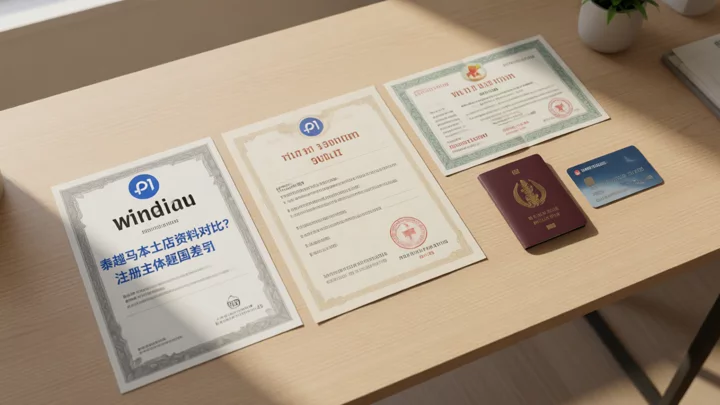
ThailandA locally registered Thai business license (or a certified subsidiary license with 100% foreign ownership) + the legal representative's passport (with a remaining validity of ≥ 12 months) + a Thai Baht bank account + a Thai warehousing address (third-party warehouse rentals are acceptable but require a contract).VietnamA Vietnamese enterprise registration certificate (Giấy chứng nhận đăng ký doanh nghiệp) + the legal representative's national ID or passport + a Vietnamese Dong bank account + a local warehouse in Vietnam.MalaysiaA Malaysian local company license or a power of attorney for an authorized representative + a Malaysian Ringgit bank account + proof of Malaysian warehousing. Cross-border stores only require a Chinese business license + the legal representative's national ID + an international receiving account (Payoneer / LianLian, etc.)—no local warehouse is needed.
Quantity boundaries: Under a single business license, TikTok Shop cross-border stores are typically limited to 1–2, while Southeast Asian local stores are capped at 1–3 each for Thailand, Vietnam, and Malaysia. The real constraint on quantity is the three-layer cross-validation threshold spanning the registration entity, the receiving entity, and the logistics entity—not simply "how many stores can one license open." The specific caps and consequences of exceeding them for each store typeHow Many TikTok Shop Stores Can One Business License Open? Store Cluster Quantity Limits and Multi-Store Operations in a Single Countryare broken down country by country.
Difference Three: Payment Collection Channels and Settlement Cycles — Shared Bank Accounts Across Multiple Stores Are More Risky Than Multiple IPs
When 3 or more local stores share the same local bank account, the platform and payment institutions cross-check the receiving entity, account number, withdrawal card, and tax information, attributing multiple stores to a single controller and triggering a fund compliance review. Cross-border stores uniformly route through the RMB international channel, while local stores use the local-currency channel; the tax filing entities for the two channels differ. The issue that surfaces first with shared bank accounts is often not the IP or browser fingerprint, but the fund chain: once the receiving entity of the 2nd store appears in the registration documents of the 3rd store, the secondary review is rejected outright for "inconsistency between receiving attribution and registration entity."What problems surface first when multiple stores share a single payment accountThis article lays out the consequences in the order they occur, with a detailed explanation. Practical advice: each domestic store in a given country should open its own local bank account, cross-border stores should maintain independent international payment accounts, and withdrawal cycles and tax filing entities should be aligned on a per-store basis.
Difference Four and Five: Second-Review Verification Chain and Ad Account, SPS Ownership
Ranked by diagnostic priority, the 5 high-frequency second-review rejection triggers are, in sequence:①ID validity period of less than 12 months (applies to both passports and national IDs);②Legal representative's ID information inconsistent with the registered entity (name, ID number, and issuing authority compared field by field);③Payment account ownership spans across stores (Store N used the bank account belonging to Store N-1);④Missing sub-account isolation (sub-accounts of different stores logging in from the same IP range or the same browser Profile);⑤Ad account association (a local store's TikTok Ads account is linked to an ad account under a Chinese entity, or a cross-border store uses an ad account under a local entity). Seethe troubleshooting checklist for SPS health score drops and secondary review failures in TikTok Shop multi-store operations.
Regarding ad account ownership: local stores must open TikTok Ads accounts bound to a locally registered entity, while cross-border stores may open accounts under a Chinese entity. TikTok officially requires advertisers to use Business Center Roles and Permissionsto manage member access and avoid sharing login credentials. In SPS calculations, the logistics tracking update frequency requirement for local warehouses (first update within 48 hours) differs from that for cross-border warehouses (72 hours); the false shipment determination criteria also vary by warehouse type—a local warehouse triggers a logistics violation if no pickup occurs within 7 days, while a cross-border warehouse allows 12 days. When multiple stores share a business license, a logistics anomaly at one store will lower the SPS of other stores under the same entity within 72 hours, cascading into a secondary review re-examination.
Group naming and sub-account permission matrix for a 4–6 store matrix
- Three-part naming: country code-store type-sequence number, e.g., TH-LC-01 (Thailand local store 01), VN-CB-01 (Vietnam cross-border store 01). For the 2nd and 3rd stores in the same country, increment the sequence number in order to avoid cross-country interleaving.
- Actions Reserved for the Main Account: Payment account changes, legal representative verification, ad account binding and unbinding, and store group adjustments—these operations can only be completed by the main account (the legal representative in person) within Seller Center and are not delegated to sub-accounts.
- Operations Delegable to Sub-Accounts: Product listing and delisting, order processing, influencer outreach, logistics tracking entry, and day-to-day store operations. Access scope is distributed through the role-function assignments outlined in the TikTok Advertiser Account Policy to prevent shared credentials.
- Environment Isolation on a Single Workstation: 4–6 stores are distributed across 2–3 browser Profiles, each bound to a dedicated proxy exit; when switching between store groups, enforce a 30-minute proxy binding cooldown. For the specific execution sequence of Profile isolation and fingerprint alignment,Environment Configuration and Group Management for Running Multiple TikTok Shop Store Groups on a Single Computera step-by-step guide is available.
SPS Drop, AHR 150-Point Threshold, and Secondary-Review Interlock
When multiple stores share a single business license, a sharp SPS drop in one store (e.g., logistics tracking data not updated for more than 48 hours, or a false-shipment flag) will drag down the account health scores of other stores under the same entity within 48–72 hours. TikTok Shop mega-promotion eligibility requires an AHR (Account Health Rating) of ≥ 150 points; falling below this threshold means you simply cannot register for S-tier mega-promotions. Practical loss-containment sequence: within 4 hours of detecting an SPS decline, halt ad spend on the affected store; within 12 hours, complete missing logistics tracking or file a delayed-pickup request; within 24 hours, submit an SPS appeal; within 48 hours, confirm that other stores under the same entity have not been impacted. If AHR is stuck around 140 points, prioritize fixing logistics tracking gaps and false-shipment records first, then address payment and secondary-review issues—reversing this order will prolong the recovery cycle. The interlock between logistics violations and secondary-review re-audits continues to tighten; SPS management across a multi-store matrix must follow the cadence of "independent monitoring per store, logistics tracking inspection every 4 hours," and the inspection frequency must not be reduced.
Frequently Asked Questions
Can you change the legal representative and resubmit after a second-review rejection?
Yes, but after changing the legal representative, you must go through the entire registration-entity verification process again (new legal representative ID + consistency check against the legal representative on the business license). If the legal representative on the license has already been changed but the platform-side sync is incomplete, the new submission will still be flagged as "ID inconsistent with the registered entity." The correct sequence is to first complete the legal representative change in the industrial and commercial registration system, then update the legal representative information in Seller Center, and finally resubmit the second-review documents.
Can a local store use a TikTok Ads account under a Chinese entity?
No. TikTok Ads for local stores (Thailand, Vietnam, Malaysia) must be linked to a locally registered entity. Cross-border stores can open an account under a Chinese entity, but if a local store links to a Chinese-entity ad account, the second review will trigger "ad account ownership inconsistent with the registered entity." Each store should open its own ad account and manage team permissions through Business Center.
If one business license has already been used to open 2 local stores in Thailand, can a 3rd store be opened?
The cap for Thai local stores is typically 1–3 per country, but whether the 3rd store can pass depends on three layers of verification: whether the receiving account is independent, whether the logistics warehouse is independent, and whether the legal representative ID has sufficient validity. If the first 2 stores already share a receiving account, the 3rd is likely to trigger a "duplicate registered entity" rejection. Split the receiving accounts first, then submit the 3rd store.
Where are the main fixed costs for a multi-store matrix in terms of receiving and logistics?
The main investments include: local bank account maintenance fees in each country, local warehouse rental (or third-party warehouse service fees), and proxy egress and browser environment costs. For 4 stores (2 Thailand + 1 Vietnam + 1 Malaysia), the monthly average fixed costs are concentrated in warehousing and proxy egress, with ad budgets calculated separately. Cross-border stores incur higher receiving fees due to international channels, but save on local warehouses and local bank account maintenance.

