



A Chinese business license for cross-border stores typically corresponds to 1–2 shops; Southeast Asian local stores are organized by country entity—Thailand, Vietnam, and Malaysia each require a local company or letter of authorization, with generally 1–3 stores under the same legal entity. "Can register" and "should register" are two different things—being able to open 5 stores doesn't mean the monthly cost of running all 5 simultaneously can be covered by gross margin. Below, we calculate the cost curves for 1 / 3 / 5 stores across five dimensions—labor, advertising, logistics, payment collection, and environment isolation—then flag four hidden pitfalls that are easy to stumble into.
How Many TikTok Shops Can One Business License Open: Quantity Limits for Cross-Border vs. Southeast Asian Local Stores
Cross-border store registration uses a Chinese legal entity. In the backend, one business license typically supports binding 1–2 stores only; beyond that, the system displays the message "This entity already has an active store." Southeast Asian local store documentation is entirely different: a Thai local store requires local business registration (or a group authorization letter + legal representative's passport), while Vietnam and Malaysia each have independent requirements that are not interchangeable. In other words, "multiple stores in one country" is constrained by the number of legal entities registered in that same country, while "stores across multiple countries" involves three separate registration processes, and the two sets of rules do not overlap.
In the 2026 policy review, the trend of tightening cross-border store quantity limits is clear: categories such as 3C and beauty have gradually moved from "one license, two stores" to "one license, one store." For local stores, Thailand and Malaysia still allow up to 3 stores under the same legal entity, while Vietnam's long tax verification cycle means that 1–2 stores is already the practical operational limit. For details on the cost structure differences between cross-border and local stores, it is recommended to first read through Cross-Border or Local Store? Type Differences and Cost Breakdown before making any store expansion decisions.
From 1 to 5 Stores: Calculating Monthly Costs Across Five Categories
Expanding stores isn't just opening another admin panel — five cost blocks scale up simultaneously:
Headcount1 store is covered by 1 person handling listing, customer service, and influencer outreach; 3 stores require 2 people (1 operations + 1 customer service/influencer liaison); 5 stores require at least 3 people, and sub-account permissions must be partitioned by "account—environment—responsible party," otherwise you risk login incidents where the same person is switching between five admin panels.
AdvertisingEach store has its own dedicated TikTok Ads account. Starting from 3 stores, it is recommended to use TikTok Business Center roles and permissionsto perform asset-level allocation, so that a restriction on one account does not halt the entire group's ad delivery.
LogisticsTracking costs grow linearly with order volume, but a false-shipment violation is categorical — a single record locks that store out of all major promotions for 30 days.
Payment collectionCross-border stores use PingPong / LianLian, while local stores use a local bank or Payoneer. 5 stores means 5 withdrawal channels, stretching the fund-aggregation cycle from T+1 to T+5.
Environment:A single physical machine runs 4–6 profiles; hardware and bandwidth costs for proxy IP cooling and browser fingerprint isolation are approximately 200–400 CNY/month/store.
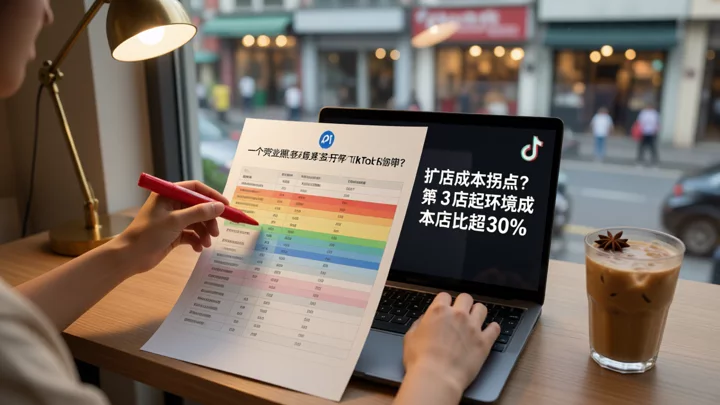
The inflection point appears at the 3rd store: for the first 2 stores, new costs are mainly ad account setup and logistics channels; from the 3rd store onward, labor and environment isolation become the primary incremental costs, and by the 5th store, environment costs already account for over 30% of total expenditure.
Second review and document verification failed: 48-hour pre-expansion self-checklist
The most common triggers for a TikTok Shop second-round review fall into four categories: failed legal representative verification (passport does not match the legal representative on the business license), duplicate qualification entities (two stores sharing the same payout account), SPS account health score below 80, and logistics violations or fake shipment records within the past 90 days. When a new store is submitted, if an existing store's SPS has already dropped below the threshold, the system directly rejects the review and flags it as "association risk."
Before expanding your store portfolio, it is recommended to spend 48 hours going through the following checkpoints:
- Legal Representative Verification— Confirm that the legal representative on the business license, the passport, and the bank account holder name are all consistent; for local stores, the signature page of the local authorization letter must also be complete without any omissions.
- Payout Account Deduplication— Bind a separate payout account to each store; the same bank card or Payoneer email must not be reused across stores.
- SPS Health Score— Log into Seller Center for each store individually to check the SPS score; for stores below 80, resolve all violations before submitting new store information.
- Logistics Tracking Spot Check— Randomly pull 5 orders and check the three tracking segments—pickup, line-haul, and last-mile; a missing segment in any part is considered a logistics violation risk.
- Environment Isolation Check— Confirm that the new store's Profile does not share any Cookie domain with existing stores, and that proxy IPs have no overlapping network ranges.
When a document review is rejected, first identify the specific field(s) that failed, correct them, and resubmit within 72 hours. Repeated submissions accelerate the SPS deduction on established stores, creating a vicious cycle.
Running 4–6 Southeast Asian local stores on a single computer: environment isolation and sub-account permission configuration
When 4–6 local stores in Thailand, Vietnam, and Malaysia are crammed onto a single physical machine, the core conflict is the number of Profiles and the proxy cooldown cycle. In practice, name each Profile using the format "Country + Store Name" (e.g., TH-StoreA, VN-StoreB, MY-StoreC), bind each Profile to a dedicated proxy exit, and keep the switching interval at no less than 30 minutes. For step-by-step configuration details on multi-store grouping, sub-account permissions, and proxy cooldown, refer to a guide to environment configuration and group management for running multiple TikTok Shops on a single computer.
Sub-account permissions are allocated according to official roles: the main account (legal representative) holds all assets; operations sub-accounts are granted access to store management + order modules only; customer service sub-accounts are granted access to messaging and logistics tracking only; ad buyers via TikTok Business Center Link the corresponding Ads account. Check permission fields module by module; do not select "All".
Grouping logic follows two dimensions: "Country × Category": Thailand-Home, Thailand-Beauty, Vietnam-3C. Groups within the same tier share a product selection pool, but ad accounts remain independent. For the workflow cadence in shop management and the three-tier staffing configurations of 3 / 5 / 8, see TikTok Shop Multi-Shop Management Guide.

Black Friday Mega Sale Registration and the AHR 150 Score: The Hidden Threshold for a Multi-Store Matrix
In the mega sale registration criteria, the AHR 150 score (Activity Health Rating) is a hard threshold that evaluates three factors: logistics tracking completeness of ≥ 95% over the past 30 days, SPS ≥ 80, and no unresolved violation records. In a multi-store matrix, the real risk is linkage—under the same legal entity, if any store triggers a fake shipment or logistics violation, the AHR of other stores will be synchronously dragged down, and the entire group loses eligibility to register.
Creator invitation distribution strategy across a store group: the same creator should not appear on more than 3 stores simultaneously (duplicate content will be flagged as low quality). Assign by "country + category," with one creator mapped to 1–2 stores. Lock in the schedule 4 weeks before Black Friday; the schedule sheet must clearly note each creator's assigned store and AHR snapshot date, so you don't discover on registration day that a store has already dropped below 150. After expanding stores, if environment anomalies or linked throttling are triggered frequently, first cross-reference the Most Troublesome Areas in Multi-Store Operations and How to Handle Them 48-hour troubleshooting sequence to identify the fault layer, then decide whether to scale down or repair.
FAQ
Can one business license really only open 1–2 cross-border stores on TikTok Shop?
For mainstream categories (3C, home, apparel), one Chinese business license currently binds to 1–2 stores. Some newly opened categories temporarily allow 3 stores, but the 2026 direction is to tighten category by category to one license per store. Follow the backend prompts at registration for specifics.
Can Southeast Asian local stores be registered with a Chinese business license?
No. Local stores in Thailand, Vietnam, and Malaysia must use a local business registration entity or a group authorization letter plus a local legal representative's passport. A Chinese business license is only for cross-border store registration.
Operating 5 local stores simultaneously, how should ad accounts be split to avoid restrictions?
One dedicated TikTok Ads account per store, with role-based permissions assigned through the Business Center to avoid multiple users logging into the same account. If the account is restricted, submit an appeal within 48 hours; all campaigns under the account are suspended during the appeal period.
If secondary review is repeatedly rejected, will established stores be penalized?
Yes. If a new store under the same legal entity repeatedly fails submission, the system will link a "document anomaly" flag to the established store's SPS, deducting 2–5 points each time. It is recommended to resolve the established store's violation records first and only submit the new store once SPS returns above 80.

