


The backend rejection notice reads: \"Legal representative document information does not match the registered entity.\" You check the name spelling character by character, confirm it's correct, and resubmit — 48 hours later, the same line appears again. Third submission, still that same one line. The problem isn't that you \"filled it in wrong.\" TikTok Shop's second review runs through a four-layer cross-verification chain, and the notice only tells you the final result, not which layer the break occurred at.
The second review isn't about whether the documents are \"correct or not\" — it's about whether the four-layer verification chain is aligned.
When investigating rejection reasons, don't just list \"possible causes 1/2/3/4/5.\" Instead, locate the issue layer by layer in causal order: the system only validates the next layer after the previous layer passes. The order is fixed as follows:
- Document Validity Period Layer: Whether the remaining validity period of the passport or ID card is ≥12 months (counted from the submission date), and whether the issue date falls within the past 5 years.
- Registered Entity Consistency Layer: Character-by-character comparison of the legal representative name, document number, and registered address on the business license against the MRO fields in the passport, including spaces and capitalization.
- Payment Attribution Layer: The account name on the receiving bank account must exactly match the full legal name of the registered entity; a shared account across multiple stores triggers entity attribution ambiguity.
- Sub-Account Isolation Layer: Whether sub-account operation logs show cross-store logistics tracking intersections or employee permissions spanning multiple stores.
Fix the layer where the breakdown occurs. If any of the layers above is misaligned, even if the remaining three layers are flawless, the second-round review will still be rejected. Each layer is expanded in detail below.
Entity Verification Layer: the real bottlenecks between passport validity and the registered entity
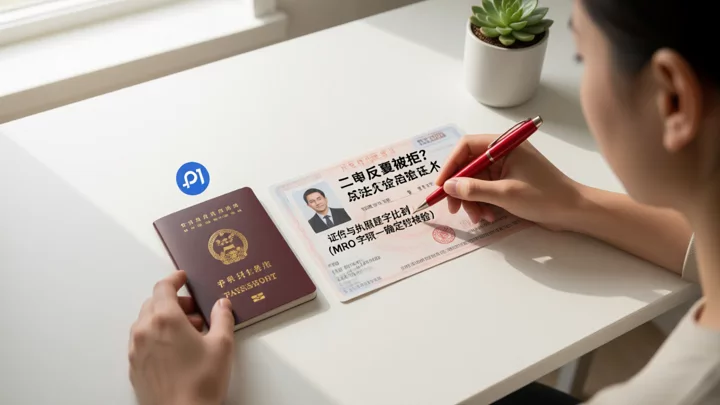
The trigger logic behind "Entity ID information does not match the registered entity" is far more complex than it appears. The most hidden bottleneck is a passport with less than 12 months of remaining validity — the backend does not flag "insufficient validity" as a separate alert but lumps it under the generic field "ID information does not match the registered entity." The second high-frequency bottleneck is a mismatch between the passport's country of issuance and the registered entity's country of registration: for example, you open a local store in Thailand, your passport was issued in Vietnam, while the business license lists Thailand as the registration location — during the three-layer cross-validation, the system flags an inconsistency. Third, whether the legal person's name on the business license follows "surname first, given name last" or "given name first, surname last," it must exactly match the order in the passport's machine-readable zone; it cannot simply "look the same."
If you want to quickly identify whether you are stuck at the ID layer or the entity layer, you can refer to the checklist we previously compiled on5 High-Frequency Reasons for TikTok Shop Second-Round Document Review Rejection and the Entity Verification Self-Check Checklist, and work through each item in order of diagnostic priority.
Payment Attribution and Sub-Account Isolation: The Most Hidden Rejection Source in Multi-Store Scenarios
Under the same business license, 2 Thai local stores and 1 cross-border store were opened, all three sharing the same receiving bank account. During the secondary review, the platform uses the 'payment entity' as key evidence to determine the attribution of the registered entity — the account name is registered under Company A, but the legal representative on one store's business license is individual B, and the system directly flags it as 'entity mismatch' and rejects it. At the sub-account level, if an employee sub-account holds logistics operation permissions for two stores simultaneously, a single erroneous operation that fills Store A's logistics tracking number into Store B's order will cause the platform to flag a 'logistics trajectory anomaly' during the next round of Health Score (SPS) calculation, triggering a secondary review cross-verification failure. For the sub-account permission matrix and group naming conventions in multi-store management, refer toOperating Multiple TikTok Shop Stores on a Single Computer: Environment Setup and Sub-Account Permission Practicesthe 5-role permission table.

Local Store Documentation vs. Cross-Border Store Documentation: Hard Differences Across Thailand, Vietnam, and Malaysia
During the secondary review, the system cross-compares whether the 'business license legal representative → payment account name → logistics contract signatory' all point to the same entity. The following fields represent structural differences between local and cross-border stores across the three countries; any inconsistency will trigger a rejection:
| Field | Thailand Local Store | Vietnam Local Store | Malaysia Local Store | Cross-border Store |
|---|---|---|---|---|
| Business License Type | Thai Local Company (SME/Public Company) | Vietnamese Local Company (Doanh nghiệp) | Malaysia SSM Registration | Chinese Business License (Sole Proprietorship/Company) |
| Legal Representative ID Type | Thai Passport or ID + Residence Permit | Vietnamese ID Card (CCCD) | Malaysian IC/Passport | Chinese ID Card + Passport |
| Tax ID Requirement | VAT Registration Number (Annual Revenue ≥ 180 Ten-Thousand THB) | MST Tax Number | Malaysia CIT Registration Number | Unified Social Credit Code |
| Logistics Contract Party | Thailand-Based Local Logistics Provider | Vietnam-Based Local Logistics Provider | Malaysia-Based Local Logistics Provider | Eligible for China Cross-Border Logistics |
| Receiving Account Type | Thailand-Based Local Bank Account | Vietnam-Based Local Bank Account | A local bank account in Malaysia | Cross-border payment collection (e.g., Payoneer) |
For a complete comparison of cross-border stores and local stores in terms of registration requirements, logistics delivery times, and AHR scores, seeDifferences Between TikTok Shop Cross-Border Stores and Southeast Asian Local Stores: How Many Stores Can One Business License Cover, and How to Pass the Secondary Review.
Linked Risks in a Multi-Store, Single-Country Setup: What Happens to the SPS of Other Stores When One Is Rejected
Item-by-Item Checklist Before Resubmission
Execute in the order of the four-layer verification chain; check all items before clicking Submit:
- Passport/ID card remaining validity ≥ 12 months (calculated from the submission date)
- The legal representative's name on the business license must match the MRO field on the passport verbatim (including spaces, capitalization, and name order)
- The account holder name on the receiving bank account = the full registered entity name on the business license
- The signing/sealing entity on the logistics contract = the registered entity on the business license (not an individual signature)
- Sub-account permissions have not extended beyond this store (check the employee permission list and operation logs)
- This store's logistics tracking numbers have not appeared in other stores' shipping records
- Store group naming is unambiguous (e.g., "Thailand Local-Beauty-A" instead of "TH-Store-1")
FAQ
After the second review is rejected, is there a time window limit for resubmission?
The platform has not set a hard deadline, but resubmissions within 7 days of rejection receive the highest review priority. If more than 30 days pass without resubmission, fields such as tax ID validity and logistics contract expiry may have lapsed and must be re-obtained before resubmission.
If one local store is rejected in the second review, will it affect the cross-border store under the same business license?
If both share the same receiving account or logistics contract entity, it will trigger a health score recalculation for the same group. Separating the receiving account and logistics contract by store type while keeping the entity name consistent will isolate the risk.
When submitting supplementary documents, should only the rejected section be corrected, or should all documents be resubmitted?
A resubmission for the second-round review is submitted as a complete package, but you only need to modify the fields in the layer that was rejected. If the other layers have no changes, they can remain as is—there is no need to retake photos or rescan everything.
When operating mixed stores across Thailand, Vietnam, and Malaysia, how should receiving accounts be allocated to avoid cross-verification failures?
Each country requires at least one independent local bank account, with the account name matching the full legal entity name on that country's business license. Cross-border stores must use a dedicated cross-border payment channel and must not share accounts with any local store. Sub-accounts are authorized only to view payment receipts for their own operational unit and must not perform cross-group operations.

