



After a team operating in the Malaysian market submitted the documents for its 4th local store, it received a secondary review notice within 48 hours—the legal representative's verification mobile number was shared with stores 1 through 3, and the platform flagged it as the same entity exceeding the limit. A Singapore cross-border store submitted in the same batch, however, passed on the first review. Same team, different store types, different review outcomes—the issue lies in the review logic itself: cross-border stores focus on platform risk control (association signals, logistics delivery times), while local stores focus on local compliance (tax registration, import permits, local bank accounts). You cannot apply a single template across an entire matrix. Below, we break things down across five layers: registration documents, secondary review paths, quantity limits, environment configuration, and compliance red lines.
Registration Documents: Cross-Border and Local Stores Require Fundamentally Different Materials
Using a cross-border template directly to fill out a local store form is the most frequent reason for secondary review rejection. The document requirement differences between local stores and their corresponding cross-border stores in Thailand, Vietnam, and Malaysia are concentrated in five fields:
| Document Item | Local Store (Thailand/Vietnam/Malaysia) | Cross-Border Store |
|---|---|---|
| Business License | Local company registration certificate (Thailand DBD, Vietnam MCP, Malaysia SSM), must match the business category | Mainland China business license, with cross-border e-commerce in the registered business scope |
| Legal representative identity verification | Local passport or national ID + proof of residential address (utility bill or bank statement) | Mainland China national ID; no proof of residence required |
| Tax registration number | Must provide local VAT/GST registration number (Malaysia 10% SST, Vietnam 8-10% VAT) | Not required; the platform withholds and remits on your behalf |
| Bank account | Local bank account in the legal representative's name, used for withdrawals | Platform payout channel (LianLian/Payoneer), no local account required |
| Import license / category qualification | Some categories require local import licenses or product certifications (Vietnamese cosmetics require NAFOSTAN registration). | Reviewed on the platform side; sellers only need to submit a certificate of origin. |
Practical advice: Before opening the 2nd local store, first log the 1st store's tax registration number, bank account opening branch, and business license registration number into a shared spreadsheet, then cross-check item by item for consistency with the 2nd entity. For stores under different legal entities, the legal representative's phone number, email, and registered address must be independent; otherwise, the secondary review will directly trigger a linkage signal. If your team is running both cross-border and local lines simultaneously, you can reference the complete breakdown of registration documentsCross-border store or local store? Type differences and cost breakdown before multi-store operations, aligning item by item against the five-layer cost structure.
The secondary review is not 'checking again': trigger reasons for the two store types and a 48-hour self-check sequence
Root causes of failed document review, split into two tracks by store type:
- Cross-border store secondary review: Focuses on platform risk control. Common triggers include multiple stores registered under the same IP range, payment account not matching the business license entity, and logistics address overlapping with operating categories (e.g., using a non-cold-chain warehouse address for food categories). The platform does not specify which rule was triggered; it only sends a 'Document Review Failed' notification.
- Local store secondary review: Focuses on local compliance. Thailand monitors whether DBD registration status is 'active,' Malaysia checks whether SSM annual fees are paid in full, and Vietnam verifies whether the MST (tax registration) is within its validity period. A failed legal representative verification usually means the phone number or email does not match the original registration information, rather than the documents themselves being incorrect.
48-hour self-check sequence (from largest to smallest contamination radius):
- Verify whether the legal representative's mobile number and email are shared with any already-registered store—if they are, an association is triggered; you must switch to a new personal number and wait for the 72-hour cooldown period.
- Confirm that the business license registration number shows a status of 'active / normal' in the corresponding country's business credit system. For Vietnam, additionally verify the MST tax registration validity period.
- Check whether the receiving bank account's issuing bank and account holder name exactly match the legal representative's name on the business license (for local stores). For cross-border stores, confirm that the Payoneer/LianLian account's linked entity matches the license.
- Log in to the backend to check whether the logistics address matches the currently listed categories. Food, cosmetics, and electronics each have specific warehousing qualification requirements.
If you still cannot identify the root cause after self-inspection, note that when the platform determines whether multiple accounts belong to the same entity, it does not rely on a single signal but instead evaluates the overlap across four layers of variables: network egress, device and browser fingerprint, identity and payment information, and behavioral trails. For a troubleshooting approach, refer toWhich dimensions does the platform typically use to determine whether multiple accounts belong to the same person?TikTok Shop's detection pipeline follows similar logic.
How many stores can one business license support? The real upper limits and grouping logic for multiple stores in one country
Local stores in Thailand and Malaysia typically follow a 'one license, one store' rule. In Vietnam, a limited number of categories allow two stores under one license (same legal representative, different operating categories), but sharing a mobile number or email will still trigger an association. The number of cross-border stores is governed by the platform's quota; a maximum of 3 cross-border stores can be operated simultaneously under one business license (subject to the actual 2026 Southeast Asia site quotas; quotas are adjusted per policy review cycles). A typical grouping plan for a 4–6 store matrix: split by 'country × store type'—for example, 2 Malaysia local + 1 Vietnam local + 1 Thailand local + 1 cross-border (covering four countries) + 1 cross-border (testing new categories), totaling 6 stores. Sub-account permissions are allocated according to official roles—TikTok Business Center roles and permissionsIt supports three roles: Admin, Standard Member, and Finance. Each store maps to one Business Center, and ad accounts are bound one-to-one with stores to prevent a shared main account from causing one store's restriction to cascade into a full-group ad suspension. Employees log in with independent sub-accounts; operation logs are retained for audit. For specific permission allocation and handover workflows, refer toHow to set up environment isolation, login permissions, and handover workflows when one team manages multiple TikTok Shop accounts.
Implementing the Matrix: Environment Isolation and Multi-Store Cost Structure
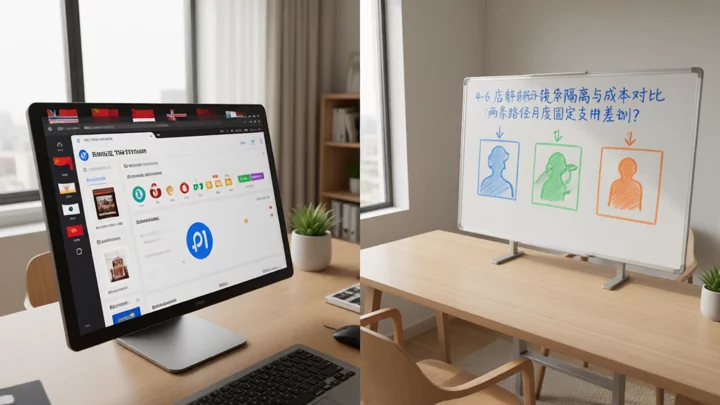
Running 4-6 local store Profiles on a single physical machine hinges on three core isolation measures: each Profile is bound to an independent proxy exit (Southeast Asian nodes, same country, same city, different IP ranges), with a post-switch cooling period of no less than 72 hours; browser fingerprints (Canvas, WebGL, AudioContext) are unique per Profile; Cookie domains are isolated per store and never shared across Profiles. For the complete environment configuration and proxy cooling-period schedule for 4-6 Profiles, see the hands-on details atRunning Multiple TikTok Shops on One Computer: Environment Configuration and Group Management Guide for the Southeast Asian Local Store Matrix.
On the cost-structure side, the monthly differences between the "3 cross-border + 2 local" and "5 all local" paths concentrate in three areas: local stores require maintaining a local corporate bank account (Malaysian SST filings, Vietnamese VAT filings) and coordinating with local logistics service providers, while cross-border stores ship via the platform warehouse or self-fulfillment but face stricter delivery-time requirements; on the advertising side, local store TikTok Ads accounts must be linked to local payment methods, whereas cross-border stores can pay from mainland China, though local store creative assets must be in the local language and influencer outreach costs run approximately 30%-50% higher; on the labor side, local store customer service must respond in the local language (Thai, Vietnamese, Malay), while cross-border stores can cover it with Chinese/English. If the team size is 3-5 people, the monthly fixed cost of "3 cross-border + 2 local" (logistics + advertising + outsourced customer service) is roughly 1.5-2 万元 lower than "5 all local," but local stores accumulate AHR scores faster and face lower barriers to entering major sales events.
Compliance Red Lines: Logistics Tracking, Payment Collection, SPS, and 2026 New Rules
The four lines are laid out item by item; tripping any one of them triggers SPS demotion or store restrictions:
- Shipping Tracking: For domestic stores, a tracking number must be returned within 48 hours of shipment; if no tracking update occurs within 72 hours, it is flagged as fake shipment, incurring a 2-point SPS deduction per instance. For cross-border stores, platform-warehouse shipments are measured by pickup time, and self-shipments with no pickup within 72 hours trigger the same penalty. The 2026 policy review for Vietnam and Malaysia introduced a tiered penalty: an automatic reminder after 24 hours of tracking update gap plus a 5-point deduction if no update within 48 hours.
- Payouts: Domestic stores must withdraw funds through a local corporate bank account; cross-border stores use platform disbursements (LianLian, Payoneer). Multiple domestic stores under the same legal entity sharing one bank account will be flagged as 'payment entity anomaly' during secondary review. Starting in 2026, the Malaysia site requires an independent account per store, and one account funding multiple stores will no longer be permitted.
- Advertising Account: After a TikTok Ads account is restricted, the recovery process involves submitting entity verification + a 7-day observation period + manual platform review, with a cycle of 10-15 business days. Black Friday major sale eligibility requires an AHR score ≥ 150 and no logistics violations in the past 30 days. The AHR score is a weighted composite of logistics timeliness, customer service response, and product ratings; a single store with SPS below 60 loses eligibility.
- SPS Health Score: A score below 60 triggers demotion (search ranking drops 3 tiers, ad bidding weight reduced by -20%), and below 40 suspends new listings for 14 days. Recovery cycle: logistics violations auto-recover points 7 days after resolution; content violations require an appeal + 7-day observation period; two cumulative violations of the same type double the recovery cycle. Advertiser conduct must comply with TikTok Advertiser Account Policy, and bypassing review or bulk account creation will directly trigger an account-level ban rather than a store-level demotion.
2026 New Policy Impact Notice: Starting from the 7th month of 2026, Southeast Asian domestic stores will be subject to mandatory 'one store, one bank account' verification. Thailand has added quarterly DBD registration verification (unverified stores face an immediate 10-point SPS deduction). Teams with existing multi-store matrices must complete account splitting and DBD verification by the end of the 6th month, or they will face batch demotion before the Q3 major sale.
Frequently Asked Questions
Can creator invitations be reused across stores?
No. Creator invitations are tied to a specific store's advertising account, and a creator invitation link is only valid at the initiating store. If the same creator services 2 local stores simultaneously, 2 separate invitations must be generated, with commission rates and material requirements configured independently for each—no sharing between them.
What is the time window for supplementary logistics tracking uploads?
Within 72 hours after shipment, tracking numbers can be manually uploaded. Beyond 72 hours, the system flags it as a false shipment, deducting 2 points from SPS and including the order in the 30-day logistics violation rate. The tracking number submitted must correspond to a genuine pickup record; a fabricated number triggers a secondary penalty (5-point deduction + 7-day listing suspension).
Can a single legal entity holding multiple business licenses bypass the one-country-multi-store restriction?
Yes, but with restrictions. Thailand and Malaysia allow multiple independent licenses under the same legal entity, each opening one store. However, the legal entity's phone number, email, and bank account must be unique per store, and the license's business scope must align with the listed categories. Vietnam has no clear cap on the number of stores under one legal entity, but shared network egress or device fingerprints will still trigger association flags. In practice, we recommend a dedicated IP + dedicated Profile per store.
Once a local store's SPS drops to 55, is its mega-sale registration automatically revoked?
Yes. AHR score is linked to SPS. When SPS falls below 60, the AHR score simultaneously drops below the 150 threshold, and the system automatically cancels the current season's mega-sale registration. After SPS is restored above 60, you must wait for the next registration window to resubmit. Once cancelled, the eligibility cannot be manually reinstated.

