



A team used the same mainland China business license to open 3 TikTok Shop local stores in Thailand. The 3rd store was rejected during secondary review, with the notice citing "duplicate registration entity." After repeatedly verifying that the legal representative's name spelling was indeed consistent, the real bottleneck was that the legal representative's passport had less than 12 months of remaining validity, compounded by the fact that stores 2 and 3 had the same bank card linked to their payment entities. Multi-store in one country is not simply "registering a few more times"—the three layers of registration entity, payment entity, and logistics entity must all be aligned simultaneously. Any layer that is not isolated will trigger a secondary review rejection.
Opening Three Thailand Stores Under the Same License: Why Was the Third One Still Rejected
TikTok Shop's secondary review does not merely check whether the documentation was filled in correctly. It cross-references three layers of entities: registration entity (business license + legal representative's ID), payment entity (bank account + tax registration), and logistics entity (SPS fulfillment capability). When opening the 3rd store under the same license, the platform scans for overlap between the first 2 stores' payment card numbers, tax registration numbers, and logistics warehouse codes against the new store. If two or more of the three layers point to the same controller without entity isolation, rejection is nearly inevitable.
A common misdiagnosis is for teams to assume that consistent legal representative names are the root cause, when in fact the "duplicate registration entity" cited in rejection notices often points to overlap in the payment or logistics entities. The troubleshooting sequence should work backward from the payment chain, not forward from document spellings. For a more comprehensive list of rejection reasons and a self-check path for legal representative verification, seeWhat to Do When Your TikTok Shop Secondary Review Fails: High-Frequency Reasons for Documentation Review Rejection and a Legal Representative Verification Self-Check List.
Item-by-Item Comparison of Local Store Registration Documentation Across Thailand, Vietnam, and Malaysia
The same license can be used to open local stores in three countries. The document framework is identical, but field requirements vary. The required fields are listed below in five rows × three columns; the team can tick off each cell for confirmation.
| Document Item | Thailand | Vietnam | Malaysia |
|---|---|---|---|
| Business License | Copy of mainland business license (unified three-in-one certificate) | Mainland business license + local Vietnam DUNS code | Mainland business license + Malaysia SSM business registration |
| Legal Representative ID Documents | Passport (validity ≥ 12 months) or national ID card | Passport (validity ≥ 12 months) | Passport or Malaysian MyKad (for local legal entities) |
| Tax Registration | Thailand VAT Registration Number (category requirement) | Vietnam Personal Tax Registration Number | Malaysia FRMy Tax ID |
| Receiving Account | Thai local bank account; the account name must match the registered entity | Vietnamese local bank account | Malaysian local bank account; Mainland China cards cannot be linked |
| Logistics Entity | Thai local warehouse or 3PL; SPS score ≥ platform threshold | Vietnamese local warehouse or 3PL | Malaysia local warehouse or 3PL |
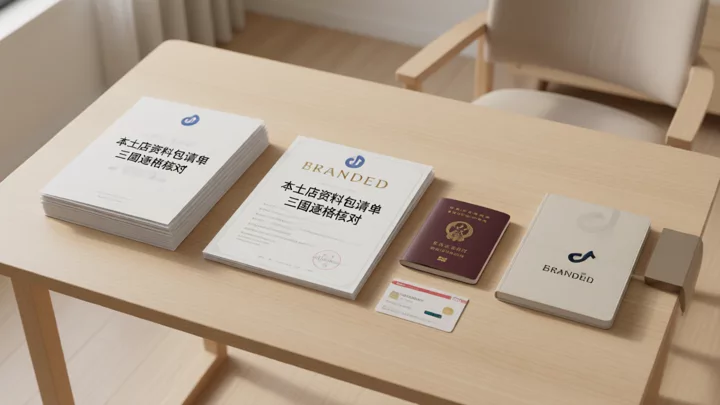
Per-country multi-shop quantity limits and second-round review trigger paths
A cross-border shop typically allows 1–2 stores under one business license; Southeast Asia local shops are planned at 1–3 per country. When Thailand, Vietnam, and Malaysia each have 1–3 stores, from the 3rd store onward the platform enters "same-entity multi-shop" strict review mode, and the probability of second-round review triggering rises significantly. For detailed quantity limits and matrix rules, refer toHow many TikTok Shop stores can be registered with one business license? Cross-border shop quantity limits vs. local shop matrix rules comparison.
5 high-frequency triggers for second-round review, ranked by diagnostic priority:
- Insufficient validity period for the legal representative's ID: Passport remaining validity < 12 months; the system automatically flags it in red. First check the document expiration date, then decide whether to renew and resubmit.
- Duplicate Payee Entity: The same bank card is linked to ≥ 2 stores, and the platform flags it as being under the same controller. Cross-check that each store's receiving card number, issuing bank, and account holder name are all independent. For details on the specific consequences of cross-referenced fund flows and tolerance differences across platforms, seeWhat Happens When Multiple Stores Share One Payment Account?.
- Logistics SPS Below Threshold: A single warehouse code serving multiple stores results in an SPS score below the threshold, triggering logistics violations and false-shipment flags. Confirm that each store is bound to an independent 3PL contract or a distinct warehouse slot code.
- Ad Account Ownership Conflict: The TikTok Ads account is linked to the wrong store entity, causing an ownership mismatch during review. Usethe TikTok Business Center Creation and Asset Ownership Guideto verify the one-to-one correspondence between ad accounts and stores, and avoid sharing Ads accounts across stores.
- Legal Entity Verification Failed: The video face-to-face interview or document OCR failed — commonly due to blurry passport photos or face-matching failures. Re-upload a high-resolution ID photo and book a face-to-face review session.
Monthly Operational Composition of a Thailand–Vietnam–Malaysia Multi-Store Matrix
The monthly cost of 4–6 stores (e.g., Thailand 2 + Vietnam 2 + Malaysia 2) is not simply the per-store figure multiplied by store count: labor and advertising enjoy economies of scale, while logistics and payment collection grow linearly per store. The following are illustrative relative indices (not actual statistics), used to gauge budget elasticity when expanding stores.
| Cost Item | 1-Store Baseline | 3 Stores | 5 Stores | Notes |
|---|---|---|---|---|
| Labor (Operations + Customer Service) | 100 | 140 | 180 | From the 2nd store onward, marginal increments decrease; shared customer service scheduling |
| Ad Placement | 100 | 210 | 320 | Multi-store AHR 150-point thresholds are each calculated independently |
| Logistics & SPS | 100 | 300 | 500 | Linear per store; each store has an independent 3PL contract |
| Payouts & Withdrawals | 100 | 280 | 440 | Each store has its own account; withdrawal fees accumulate per transaction |
| Environment isolation (proxy / Profile) | 100 | 160 | 220 | Marginal costs decrease; a shared workstation is sufficient |
Black Friday mega-sale registration requires each store's AHR to reach 150 points (covering logistics, after-sales, and response), and if 2 out of 5 stores in the matrix fail to meet the AHR threshold, the entire group's registration eligibility is restricted. Before expanding, confirm that each store's SPS health score is above 4.2; otherwise, additional orders cannot be fulfilled within the promotional window, resulting in a loss of seasonal traffic weighting.
Grouping architecture and sub-account permission setup for a 4–6 store matrix
The core of a working matrix is not 'how many stores you open' but 'who manages which store, where the permission boundaries are, and how to hand over after someone leaves.' A two-level grouping is recommended: the first level by country (TH / VN / MY), the second level by store number. Use a unified naming convention of 'country code-store number-category abbreviation,' e.g., TH-01-Cosmetics, to facilitate backend filtering and ad account mapping.
- Set up Business Center asset groups: In TikTok Business Center Roles and Permissionsby country, create 3 asset groups, each linked to all TikTok Ads accounts and stores in that country. The admin role is reserved for only 1 person (team leader); standard members are assigned by country; the finance role is opened to only 1 person. Avoid sharing login credentials—use role-based access instead of distributing passwords.
- Sub-account permission minimization: Operations sub-accounts only have edit access to stores in their assigned country, with no cross-country permissions; customer service sub-accounts only have access to messaging and after-sales modules; ad optimizer sub-accounts only have access to the Ads dashboard and cannot touch store settings. Export the permission field reference table as a shared document, and revoke permissions item by item on the employee's last day, then freeze the old Profile.
- Profile isolation and proxy binding: When a single workstation runs 4–6 stores, each store uses a dedicated browser Profile or a separate browser instance, paired with a dedicated proxy exit. Before switching stores, clear Cookies and wait 30 seconds for the proxy cooldown to prevent fingerprint variables from cross-contaminating between stores. For the specific setup steps and the 48-hour self-inspection checklist, seeHow to Run Multiple TikTok Shops on One Computer: Store Group Environment Setup, Sub-account Permissions, and Multi-Store Grouping in Practice.
- Anti-linking self-inspection cycle: Every two weeks, run a four-layer variable overlap check (network exit, device fingerprint, identity/funds, and operation trail). If any layer shows cross-store sharing, flag it as a risk item and isolate it within 48 hours. For the complete troubleshooting logic and commonly overlooked details, seeTikTok Shop Anti-Linking Isn't Just About Changing Your IP: A Comparison of Easily Overlooked Details in Multi-Store Operations.

Frequently Asked Questions
How many local stores can be opened under one business license in Thailand?
The practical upper limit is 3 stores. From the 3rd store onward, the platform enters strict review; the payment-receiving entity and the logistics entity must be fully independent, otherwise the probability of rejection in the second review is extremely high. Exceeding 3 stores requires a new license or a new corporate entity.
Can cross-border stores and local stores be operated together within the same team?
Yes, but the payment collection chains must be separated: cross-border stores use mainland China receiving accounts, while local stores use local accounts in each respective country. Ad account ownership must also correspond one-to-one; mixing them will trigger an entity mismatch review, resulting in restricted Ads accounts.
Can sub-accounts manage multiple stores across different countries?
Not recommended. Sub-account permissions in the TikTok Shop backend are assigned at the store level. Cross-country management means one sub-account holds editing rights for 4–6 stores, making the revocation radius too large after an employee departs. Splitting sub-accounts by country is the lowest-risk approach.
What impact will the new TikTok Shop rules in 2026 have on multi-store matrices?
The SPS health score threshold is raised to 4.2, and an AHR of 150 points becomes a hard requirement for major sale enrollment; payment entity isolation review for multiple stores under the same license is stricter, with cross-checking of funding chains triggered from the 2nd store onward. Before expanding, it is recommended to first confirm that SPS and AHR of all current stores meet the thresholds, then plan the pace of new store registration.

