



The rejection notice in the dashboard reads 'Legal representative credential information does not match the registered entity.' You check the name spelling letter by letter, verify the Chinese-English correspondence, and confirm the Unified Social Credit Code — all correct. You resubmit for re-review and get rejected again. What is actually holding you up is rarely the name itself. It is usually the passport or business license having less than 12 months of remaining validity, combined with three layers of misalignment: the registered entity, the receiving account holder name, and the logistics contract signatory. Below, we unpack the validation chain layer by layer, then move into day-to-day management of a multi-store matrix.
The 4-Layer Validation Chain Behind Second-Round Rejections: Why a Correct Name Still Triggers an 'Inconsistent' Flag
TikTok Shop's second-round review does not merely compare names. Behind the rejection message 'Legal representative credential information does not match the registered entity' sits a 4-layer cross-validation system: the first layer checks remaining document validity (passport, business license, and local company records must all be ≥ 12 months); the second layer verifies that the registered entity name matches the business license field by field (including English abbreviations, spacing, and capitalization); the third layer confirms the receiving account holder name equals the store's registered entity name; the fourth layer checks whether any sub-accounts are shared across entities. A break at any layer triggers the system's automatic rejection. For a detailed breakdown of rejection-reason distributions and a legal-representative verification self-check list, refer to5 Common Reasons TikTok Shop Second-Round Document Review Fails, and a Legal-Representative Verification Self-Check List.
How Many Stores Can One Business License Open: Cross-Border Store and Thailand–Vietnam–Malaysia Local Store Quotas
What constrains the number of stores is not the number of license copies, but the three-layer cross-verification threshold across the registered entity, payment-receiving entity, and logistics entity. Under the same Chinese business license, cross-border stores are typically limited to 1–2; Southeast Asian local stores are calculated separately per country: Thailand 1–3, Vietnam 1–3, Malaysia 1–3. Once the quota is exceeded, the system no longer accepts new registrations—this is not a secondary-review rejection—you will see a "This entity has reached its cap" notice directly at the registration entry point. For a full breakdown of the quota and over-limit determination logic, seeHow Many TikTok Shop Cross-Border Stores Can One Business License Open? Store Cluster Quantity Limits and One-Country-Multi-Store Practice in Southeast Asia.
| Country / Region | Cross-Border Stores (Chinese License) | Local Stores (Local Entity or Authorization) | Total Available |
|---|---|---|---|
| Thailand | 0–1 | 1–3 | 1–4 |
| Vietnam | 0–1 | 1–3 | 1–4 |
| Malaysia | 0–1 | 1–3 | 1–4 |
| Cross-border (shared Chinese license) | 1–2 | — | 1–2 |
Note: The cross-border store quota is aggregated across all Southeast Asian sites under the same Chinese business license; the local store quota is calculated independently by country. Actual limits are subject to real-time prompts at the registration portal.
The real divergence between cross-border and local stores: registration entity, payment collection chain, and logistics fulfillment
Cross-border and local stores are not simply a matter of "different interfaces"—the differences manifest at every node of the three-layer cross-validation. Registration entity layer: cross-border stores use a Chinese business license + legal representative ID; local stores require a local company file or an authorized agent (from 2026, Malaysia tightens pure agent registration, requiring local shareholder equity ≥ 30%). Payment collection layer: cross-border stores use cross-border payment channels such as PingPong and LianLian; local stores must use a local bank account, and the account holder name must respectively match each store's registration entity. Logistics fulfillment layer: cross-border stores ship directly from a China warehouse, with the platform allowing a 72h pickup window; local stores require 48h fulfillment from a local warehouse, and the logistics contract signatory must be the local registration entity or a platform-approved 3PL partner. A break at any of the three layers triggers a secondary review rejection or an SPS (i.e., Store Health Score) deduction. For an item-by-item comparison and AHR weight differences, seeHow to choose between TikTok Shop cross-border and local stores: the differences you must understand before expanding into Thailand, Vietnam, and Malaysia.
| Validation layer | Cross-border store requirements | Southeast Asia local store requirements | AHR weight impact |
|---|---|---|---|
| Registration entity | Chinese business license + legal representative ID | Local company file / authorized agent (Malaysia requires local shareholder ≥30%) | Entity mismatch triggers an immediate SPS −20 |
| Payment collection chain | Cross-border payment channel; account name = Chinese entity | Local bank account; account name = local entity | Payment attribution break triggers secondary review |
| Logistics fulfillment | Direct shipment from China warehouse, 72h pickup | Local warehouse 48h; contracting party = local entity or 3PL | Logistics timeliness weight increased to 25% in 2026 |
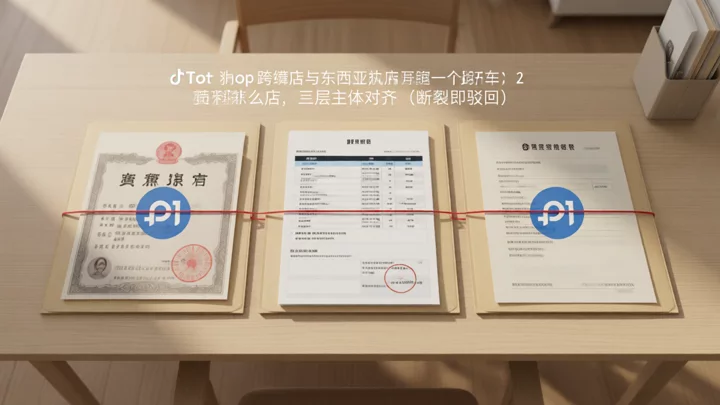
Secondary review document self-check: a 5-step diagnosis from rejection to resubmission
After rejection, a 7-day cooling period begins. During this period, you may modify your information but cannot resubmit the same version. Once the cooling period ends, troubleshoot layer by layer in the following order. If any layer fails, stop immediately, resolve the issue, then proceed to the next layer:
- Remaining validity period of the document ≥ 12 months.For cross-border stores, check the legal representative's ID and the annual business license inspection validity; for local stores, check the passport (common for Thailand, Vietnam, and Malaysia) or the local company registration document validity. A passport with less than 12 months remaining is the most frequent hidden blocker—even with a correct name, it will not pass.
- The registered entity name must match field by field.The full company name on the business license (including suffixes such as "有限公司" or "Co., Ltd.") must be completely identical to what is entered on the TikTok Shop registration page. English abbreviations, spaces, and capitalization must not be omitted or substituted.
- Receiving account holder name = store's registered entity name.Cross-border stores: The PingPong/LianLian account holder name must be the full name of the Chinese company; local stores: The local bank SWIFT account name must be the local company name or the legal representative's name. Sharing a receiving account across different entities will directly trigger cross-entity fund-flow comparison. For consequences, seeWhat happens when multiple stores share one receiving account.
- Sub-accounts must not be shared across entities.Check whether in Business Center the same sub-account has been authorized to stores under different registered entities. FollowTikTok Business Center Role and Permission Guide, roles should be bound to a single entity to prevent a Store A financial account from simultaneously operating Store B's ads.
- Logistics tracking must match the declared fulfillment method.If a cross-border store order is routed through a local 3PL warehouse but declared as 'Direct Shipment from China,' the system will flag it as false fulfillment. For domestic store orders, failure to collect within 48h results in a 15-point SPS deduction. Tracking nodes must correspond one-to-one with backend declarations.
Impact of 2026 Policy Changes on Quotas and Secondary Review
In 2026, TikTok Shop added a legal representative facial verification step to the secondary review process (applicable to domestic stores). In the AHR scoring system, the logistics timeliness weight has been increased from 15% to 25%, and an AHR score of 150 remains the hard threshold for Black Friday mega-sale registration—falling below this score makes registration impossible. Domestic stores are more likely to lose points on the logistics dimension due to the 48h fulfillment requirement. Registration entity requirements for Malaysian domestic stores have been tightened: the pure agency model no longer accepts new applications, and a local shareholder must hold ≥ 30% equity. These policy changes directly affect the practical number of stores that can be launched under a single license (the quota for Malaysian domestic stores is recalculated after switching from an authorized agent to a local shareholder model) as well as the verification items for passing the secondary review (the newly added facial verification step must be recorded in advance). The 48-hour stop-loss sequence for SPS sharp drops and secondary review failures can be cross-referenced withTroubleshooting Checklist for SPS Health Score Drops and Secondary Review Failures in TikTok Shop Multi-Store OperationsExecute.

FAQ
How long before the platform triggers cross-referencing when multiple stores share a single cross-border receiving account?
Cross-referencing is not time-triggered but triggered by transaction-flow overlaps. When two stores' incoming payments show overlapping amounts or refunds flowing back to an account outside the store's own entity within the same calendar month, the system immediately flags the anomaly and typically issues a fund-flow audit notice within 48–72 hours. The anti-money-laundering rules of cross-border payment channels (PingPong, LianLian) may also trigger alerts before the platform's own warnings.
What can you do during the 7-day cooling period after a second-review rejection?
You can edit your information and save a draft, but you cannot submit for re-review. Use these 7 days to complete the layers that did not pass in the 5-step diagnostic: switch to a passport with sufficient validity, align the name on the receiving account with the registered name, and clean up cross-entity sub-account authorizations. At 00:00 on the day the cooling period ends (platform timezone), you can resubmit.
A Thailand local store without a local company was rejected on second review after registering through an authorized agent. Should you change the entity or change the country?
First, check whether the rejection reason falls under the entity layer (agent registration documents missing local shareholder proof) rather than a data entry error. If it is an entity-layer issue and Malaysia/Thailand have tightened the pure-agent model in 2026, changing the entity means a new company file + a new bank account, with a cycle of 3–5 weeks. If Vietnam's quota is not yet filled and the operations team can be reused, prioritize opening a local store in Vietnam as a transition to avoid repeatedly consuming second-review cooling periods in Thailand.

