



Wednesday 14:07, the SPS of Thailand's 2nd local store dropped from 92 to 31. 5 minutes later, the Vietnam cross-border store followed, falling to 44. At 14:32, the Malaysia local store triggered a second-review recheck. At 15:01, 4 out of the same batch of 6 stores were flagged for "logistics trajectory anomaly." Post-incident review revealed the root cause was not an IP leak: a sub-account mistakenly selected Vietnam's logistics template while batch-shipping on the Thailand store, and the Payoneer withdrawal card shared by both stores was mapped to the same controlling party by the platform, triggering a cross-verification on the payment chain. The exposed issues concentrated on two layers—the shared layer (receiving entity, business license, ad accounts) and the single-store layer (SPS, logistics, sub-account operations). Most sellers only ran into trouble after scaling to more than 4 stores, when the two layers got mixed together.
Troubleshooting order: first identify whether the fault lies in the shared layer or the single-store layer
30-minute self-check sequence:① Check receiving account ownership—is the same Payoneer / Wise linked to withdrawal cards for more than 2 stores? ② Check whether the business license entity has exceeded the limit (see the country-by-country comparison below). ③ Check whether any sub-account has operated on logistics or inventory across stores. ④ Check whether TikTok Ads accounts have been suspended due to Business Center group-wide asset restrictions. The first two items belong to the shared layer; the last two belong to the single-store layer. A shared-layer fault affects all linked stores simultaneously, while a single-store-layer fault typically impacts only 1–2 stores. For a detailed troubleshooting checklist, refer to TikTok Shop Store Group SPS Crash and Second-Review Failure Troubleshooting Checklist.
How Many TikTok Shop Stores Can One Business License Open: Thailand, Vietnam, and Malaysia Country-by-Country Comparison
- Cross-border store (Chinese entity):A single business license on the TikTok Shop cross-border channel is typically capped at 1–2 stores; exceeding that limit usually results in rejection at secondary review. Cross-border store registration requires a domestic enterprise license, payments are routed through the cross-border channel, and logistics are fulfilled by the platform or a third-party overseas warehouse.
- Thailand local store:The same registered entity (a Thai company or affiliated legal person) may open 1–3 stores. Frequent secondary review blockers: the legal representative's passport has less than 12 months of remaining validity, and the payee entity name does not match the registered entity name.
- Vietnam local store:The same 1–3 store cap applies, but Vietnam local store documents additionally require that the TCC (business license) and tax number be under the same entity. The legal representative verification includes one extra bank-statement check compared to Thailand.
- Malaysia local store:1–3 stores. The local store's business license (SSM registration number) and the payee entity must be the same legal entity; cross-border stores and local stores cannot share the same payee account.
What truly constrains the store count is not the "number of licenses" but the three-layer cross-verification thresholds across the registered entity, payee entity, and logistics entity. A single license is theoretically sufficient to open stores, but once payments and logistics are shared across stores, the platform will attribute multiple stores to the same controller during secondary review, triggering rejection. For a detailed breakdown of quantity limits and local store documentation differences, see How Many TikTok Shop Cross-Border Stores Can One Business License Open.
Profile Isolation and Proxy Binding on a Single Workstation
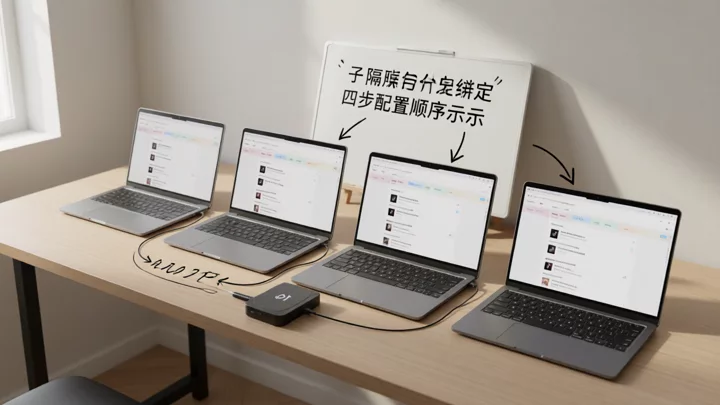
4–6 stores sharing a single physical workstation — the core principle is not "switching IPs" but ensuring that each Profile's fingerprint, proxy, and entity information remain non-overlapping. Execute the following four steps in sequence:
- Profile Naming and Isolation Boundaries.Name each browser Profile using the "Country-StoreType-Number" format (e.g., TH-Local-01, VN-CB-01). Cookies and LocalStorage are stored independently per Profile; sharing any login state across Profiles is prohibited. 4–6 stores correspond to 4–6 Profiles — do not reuse.
- Proxy Binding and Cooldown Timing.Bind each Profile to a dedicated residential proxy exit. The same proxy must not be used by two Profiles within a 30-minute window. Set a 5-minute cooldown after switching proxies to prevent fingerprint databases from linking the same exit to two stores. Keep the proxy rotation log in a local spreadsheet; do not store it inside the Profile.
- Entity Alignment Verification.After each Profile logs in, first verify that the registered entity name and receiving entity name displayed in the Seller Center match your preconfigured values. If there is a mismatch, halt operations immediately and investigate at the shared layer. This step is the last line of defense against entity misalignment caused by a sub-account accidentally switching to the wrong store.
- Ad Account Attachment.TikTok Ads accounts are managed by Business Center groups; each store's Ads account is attached exclusively under that store's corresponding Business Center. TikTok's official documentation clearly specifies the roles and permissions within Business Center — Admins, Standard Members, and Finance roles each have different visible asset scopes. Do not share admin credentials. See TikTok Business Center Roles and Permissions Documentation.
For more granular fingerprint configuration and the complete 4–6 store workflow, refer to Running Multiple TikTok Shop Stores on One Computer: A Practical Guide to Environment Isolation and Account Fingerprint Configuration.
5-Role Sub-Account Permission Matrix and Operational Unit Grouping Naming Convention
The grouping axis is the "operational unit" rather than country or store type. One operational unit = the same receiving entity + the same logistics warehouse + the same product category, typically corresponding to 1–2 stores. The minimum permission sets for the 5 roles are as follows:
| Role | Visible Stores | Permitted Actions | Off-Limits |
|---|---|---|---|
| Owner / Finance | All Stores | Payout binding, withdrawal, secondary review document submission, Business Center admin | — |
| Store Manager (1 per unit) | 1–2 stores in this unit | Product listing & delisting, inventory, logistics shipping, SPS viewing | Payout entity change, cross-unit operations |
| Operations Customer Service | This unit | Buyer messages, after-sales tickets, sending influencer outreach scripts | Shipping, refund approval, ad bidding |
| Influencer Outreach Specialist | This unit | Creator Square filtering, DMs, and collaboration link generation | Order data, shipping information |
| Outsourced customer service | Designate 1 | Operations limited to within message reply templates | All financial and logistics actions |
Each TikTok Shop sub-account is bound to a specific store according to the matrix above; "store-wide visibility" permissions are not granted. For the permission design logic and naming conventions, see From Sub-Account Permissions to Multi-Store Grouping: Day-to-Day Management Workflow and Common Pitfalls in Store Cluster Operations.

High-frequency cross-contamination points across logistics, payment collection, and Ads accounts
- Sub-account cross-store shipping:A Thai store sub-account mistakenly applies a Vietnamese store's logistics template, prompting the platform to flag it as a "fake shipment" or "abnormal logistics tracking." SPS immediately deducts 40–60 points, with no recovery possible within 72 hours.
- Multiple stores sharing Payoneer / Wise withdrawal cards:Once payment recipients are attributed to the same controller, any store triggering financial risk controls will cascade-freeze the withdrawable balances of all other stores. Each store's withdrawal card must correspond one-to-one with its registered entity; cross-use is not permitted.
- TikTok Ads account restriction cascades to the entire group:When one store's Ads account is restricted due to creative violations and that account shares the same Business Center with other stores, all group assets enter the review queue. Until the restricted account files an appeal within 7 days, active ads from other stores in the same group will also be paused. TikTok's compliance requirements for advertiser conduct are detailed in Advertiser Account Policy.
- Influencer invitation data cross-contamination:A collaboration link generated by the same sub-account on Store A is used by an influencer on Store B. The resulting attribution misalignment contaminates the traffic data of both stores, affecting the AHR 150-point threshold calculation for subsequent TikTok Shop Black Friday registration.
- Mega-sale eligibility miscalculation:When consolidating SPS across multiple stores, cross-store logistics violations are incorrectly attributed to a single store's score, causing a store that already meets the 150 threshold to be misjudged as non-eligible and miss the TikTok Shop mega-sale registration window.
Key Points for Ongoing Maintenance in Multi-Store Environments
Environment configuration is not a one-time task. Within each operational unit, the binding relationships among Profiles, proxy egress points, and receiving entities must be verified on a quarterly basis: confirm that the legal representative's passport validity is ≥ 12 months, that the business license annual inspection has not expired, that each store's withdrawal card still corresponds one-to-one with the registered entity, and that no unauthorized changes have occurred to member roles in Business Center. Any drift in a single item could be caught by the platform during the next secondary review or major promotional audit, triggering a group-wide joint re-review. Maintenance actions should be logged in the local operations log, managed jointly with the proxy rotation log, and must not be written into any Profile internally.
Frequently Asked Questions
Does a single business license count toward independent quotas in Thailand and Vietnam, or is it calculated as a combined total?
Quotas are calculated independently by country. The same Chinese entity can open 1–3 local stores in Thailand and another 1–3 in Vietnam; the quotas in the two countries do not offset each other. However, cross-border stores (where a Chinese entity registers directly) are limited to 1–2 across the entire platform, separate from local store quotas. The shared-layer risk is: if you use the same Payoneer card to collect payments for local stores in both Thailand and Vietnam simultaneously, the platform will attribute the funding chain to the same controlling person.
Are TikTok Shop sub-account permissions and TikTok Ads permissions under the same system?
No. Shop sub-accounts are authorized at the store level within the Seller Center, while Ads permissions are authorized at the asset level within Business Center. The two systems are independent. A Shop store manager account cannot automatically operate Ads accounts; the member must be separately invited in Business Center and assigned a finance or standard role. Avoid managing both sets of permissions under the same individual, as this makes it easy to overstep authority when operating across stores.
When several withdrawal cards are linked by the platform, are all funds frozen or only the amount from the triggering card?
Typically, the platform first freezes the same-day withdrawable balance of the triggering store, while the remaining stores enter a "pending verification" status within the 48–72 hour window—funds are not immediately frozen but withdrawals are suspended. If the appeal is not successful within 7 days, all store balances under the same receiving entity are transferred to a reserve fund. The specific unfreezing timeline is subject to notifications in the Seller Center; for detailed chain analysis, see What happens when several stores share a single receiving account.
Is the AHR score of 150 calculated independently across multiple stores or combined?
Each store is calculated independently. AHR is derived by weighting a single store's return rate, dispute rate, logistics timeliness, and SPS; it is not aggregated across stores. However, if two stores share a logistics template or warehouse, the logistics timeliness denominator is stretched, causing a single store's AHR to be artificially low. To troubleshoot, check whether the warehouse shipment nodes on the "Logistics Tracking" page point to the same WMS order number range.

