



Hour 41 after the 7th Vietnamese local store submitted its second review, SPS in Thailand Group 2 and Local Group 3 simultaneously dropped from 92 to 61, the Black Friday enrollment channel was closed, and 3 associated TikTok Ads accounts were flagged as restricted. The root cause was not an insufficient number of business licenses; rather, when 7 stores shared the same payment entity, the platform risk-control system treated the 7th store's failed document review as a trust collapse across the entire entity group. The real answer to "How many TikTok Shops can one business license support" lies not on the license page but in the first layer to break in the three-layer cross-verification of registration entity, payment entity, and logistics entity.
The 7th Store's Second Review Triggers a 48-Hour Cascade: The True Face of the Quantity Limit Problem
Incident timeline: At hour 41, SPS dropped sharply in a linked cascade; at hour 43, Black Friday enrollment eligibility lapsed; at hour 47, TikTok Ads accounts entered restricted status; at hour 48, the operations team finally identified the break point at the payment entity layer rather than an individual store violation. The 7 stores were distributed across 3 groups in Thailand, 2 groups in Vietnam, and 2 groups in Malaysia, all registered under the same Chinese business license and the same cross-border payment account. When the 7th store (Vietnam's 3rd local store) submitted its second-review documents, the platform detected that 6 stores under that payment entity were already in review or already open, automatically triggering a full-group SPS re-verification.
What this means: if you hold 2 business licenses, you can theoretically open 4 cross-border stores plus up to 9 local stores. In practice, however, the second-review pass rate for stores 5 through 7 drops off a cliff, because the constraining variable is the number of stores under the same payment entity, not the number of licenses. For a detailed breakdown of additional licenses and registration thresholds, seeRegistration Thresholds and Second-Review Differences for TikTok Shops Under a Single Business License.
Registration Quantity Limits for a Single Business License Across Countries
Under the current Q4 2025 rules, under the same business license (same unified social credit code): cross-border stores are limited to 1–2; Thai local stores, 1–3; Vietnamese local stores, 1–3; Malaysian local stores, 1–3. Counting is independent by country—"multiple stores in one country" does not mean "multiple stores globally"—opening 3 local stores in Thailand does not affect opening another 3 in Vietnam. However, if all local stores share the same Chinese license as the registration entity, they are all counted in the same entity's pool of pending and active stores and are calculated collectively during the second review.

Three-Layer Cross-Validation: Why N Licenses Do Not Equal N×3 Stores
When the platform reviews a local store registration, it actually runs three verification chains: the registration entity (business license plus legal representative ID plus local authorization letter or local company entity), the payment entity (cross-border receiving account or local bank account), and the logistics entity (bound logistics provider and shipping trajectory records). If any of the three chains shows "multiple stores clustered under the same entity" or "inconsistent document versions," the secondary review is triggered. 3 licenses theoretically correspond to 3 cross-border plus 9 local stores, but when the 5th local store is submitted, the platform's risk-control model has already bundled the logistics trajectories, SPS records, and TikTok Shop violation history of the previous 4 into the same entity's risk profile, making the secondary review rejection probability significantly higher than for the first 4.
This is also whythe troubleshooting path from legal representative verification to account health score after a TikTok Shop secondary review rejectionemphasizes "do not just change the legal representative's name"—the real blockers are often a passport with less than 6 months remaining validity, an entity type (sole proprietorship vs. limited company) that does not match the store type, or 3 consecutive shipments with no pickup records in the logistics trajectory.
Real Blockers in Secondary Review Rejection and AHR/SPS Thresholds
- Legal representative verification mismatch: The legal representative name on the business license does not match the OCR recognition of the ID card or passport. The secondary review rejects it directly without entering the manual review stage.
- Insufficient passport validity: When the remaining validity is less than 90 days, the local store registration entity review marks it as "expired documents," requiring a new passport to be issued and the full set of documents to be resubmitted.
- Entity type mismatch: Registering a local store that requires a company-level authorization letter (e.g., the 3rd store in Thailand) using a sole proprietorship license triggers TikTok Shop secondary review.
- Missing Logistics Tracking: Within the past 30 days, any store under this entity has 3 or more orders with no pickup or delivery-confirmation records. SPS is deducted to below 70, and the TikTok Shop account health score drops simultaneously.
- False Shipment Records: Flagged by the platform as "tracking number inconsistent with shipping label information." AHR is immediately dropped to below 100, Black Friday enrollment eligibility is invalidated simultaneously, and the TikTok Ads account is restricted.
AHR 150 is the hard threshold for TikTok Shop Black Friday enrollment; SPS 80 is the minimum score that keeps a TikTok Ads account from being flagged as restricted. Once both fall below their thresholds, penalties do not apply to a single store in isolation — they cascade across all stores under the same payment entity. For TikTok's official advertiser-account compliance requirements, refer toTikTok Advertiser Account Policy.
From Multi-Store in One Country to a Three-Dimensional Matrix: Grouping, Sub-Accounts, and Single-PC Environment Setup
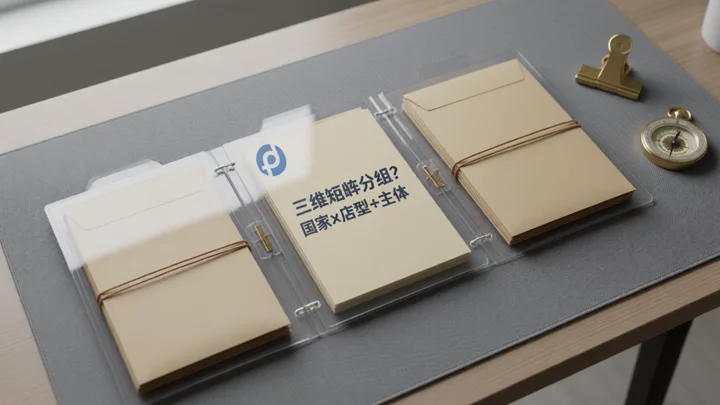
The ideal structure for 6 to 10 stores is not a flat country-by-country layout but a "country group × store type × entity" three-dimensional matrix: Thailand group (1 cross-border + 2 local), Vietnam group (1 cross-border + 3 local), Malaysia group (1 cross-border + 2 local), with each group bound to an independent payment account. Sub-account permissions are allocated across three roles — operator, finance, and logistics. Finance sub-accounts are bound only to their own group's payment account, while operator sub-accounts can only access their group's store backend. TikTok's official Business Center role-permission system supports asset-granularity access allocation, eliminating the need to share login credentials. SeeBusiness Center Roles and Permissions Guide.
When a single workstation runs multiple stores, the core is browser fingerprint isolation: each store group uses an independent browser Profile (separate Cookie domains, separate Canvas fingerprint, separate WebRTC configuration), preventing 10 store windows from sharing the same set of browser characteristics. For specific grouping rules and Profile isolation operations when running multiple TikTok Shop store groups on one computer, refer toMulti-store grouping and sub-account configuration for managing 10 TikTok Shop store groups on one computer.
Monthly cost P&L for 10 stores and the ranking of the first point of failure
Monthly fixed cost ranges for 10 stores (3 cross-border + 7 local): payment account fees are calculated at 1.2% to 1.8% of GMV; with 10 stores generating approximately 50 ten-thousand USD in monthly GMV, the monthly fee ranges from 6 000 to 9 000 USD. Logistics tracking compliance costs 0.3 to 0.8 USD per order, covering pickup and delivery tracking for all 10 stores. SPS maintenance investment is 50 to 100 USD per store per month for creator outreach and content ad spending to maintain scores. TikTok Ads account management requires 1 ad account per group; 3 groups means 3 accounts, with monthly ad budgets calculated separately. Staffing for TikTok Shop multi-store management is approximately 2 people per group; 6 people total for 10 stores can cover daily operations.
At a scale of 8 or more stores, the ranking of the first point of failure is: payment entity concentration (a single entity linked to 5 or more stores triggers a risk-control review) > logistics tracking compliance (3 stores under any entity sharing the same logistics provider causes tracking overlap) > sub-account permissions (operator misoperations across store groups) > browser environment (fingerprint leakage triggering SPS cascading effects). Operational staffing is actually not the bottleneck. For more cost breakdown and matrix building details, seeBuilding and cost breakdown of the Southeast Asia local store matrix.
Frequently Asked Questions
Can switching to a new payment entity reset the 'stores per entity' count?
Yes. Platform risk control aggregates stores under review and active stores by payment entity ID. Switching to a new payment entity is equivalent to opening a new independent pool. However, the registered entity under the same business license remains unchanged; secondary review still validates license consistency. Switching entities only resolves the accumulation at the payment layer, not the document conflicts at the registration layer.
How long does it take for AHR to return to 150 points after the second review is approved?
Approval of the second review only restores the store's basic eligibility. For AHR to recover, a continuous 14 to 21 days with no violations, complete logistics tracking, and no refund anomalies is required. During this period, the Black Friday registration channel will not open immediately; it is only unlocked once AHR actually returns to 150 and no further point deductions occur by T+3.
If two different business licenses are registered under the same legal entity, does the platform link them?
The platform performs association identification at the legal entity level. If both licenses share the same legal entity, the same registered address, or the same individual passes legal entity verification on the receiving account, the system classifies both companies as an "associated entity group," and the number of listed stores is calculated cumulatively during the second review. Holding two licenses under the same legal entity does not equate to two independent pools.
Must the local entity used to register a local store be identical to the legal entity on the business license?
Not necessarily. A local store can use a locally registered company (such as a Thai limited company or a Vietnamese joint venture) as the registration entity, with the Chinese business license serving as the authorizing party. In this case, the three-tier chain of registration entity, receiving entity, and logistics entity is decoupled from the Chinese license; however, the second review still requires that the legal entity signature on the Chinese license matches that on the authorization letter.

