



Core Comparison: License Quota, Second-Review Bottlenecks, and Monthly Cost Difference in a 7-Store Matrix
Using "2 cross-border + 3 Thailand + 2 Vietnam" totaling 7 stores as the baseline, the three key conclusions are as follows:License Quota— A single mainland China business license supports at most 1–2 cross-border stores, while each Southeast Asian local store must correspond to a local entity (1–3 stores per license). In a 7-store matrix, the registration entity layer branches into three groups: "China ×1 + Thailand ×1 + Vietnam ×1";Second-Review Pass Rate— The three-layer entity structure of cross-border stores (China registration + cross-border logistics + USD/CNY payment collection) is naturally aligned, whereas any misalignment in a single layer of a local store triggers a "legal entity verification mismatch" or "document review failed" rejection, resulting in a significantly lower pass rate than cross-border stores;Cost Structure—At a 10-store scale, the local matrix shows a marked shift in the monthly expenditure structure for license annual reviews, multi-country payment channels, and local logistics contracts compared to a flat cross-border layout (see the bar chart below for relative indicators only; not actual amounts). Within 6 hours of the 7th Vietnamese local store submitting its second-round review, the SPS of 3 stores in the Thailand group dropped from 92 to 41 in the same step, 2 stores in the Malaysia group simultaneously triggered ad-eligibility restrictions, and 4 associated TikTok Ads accounts were flagged as "ad restrictions"—this causal chain confirms that cross-group transmission speed at matrix scale far exceeds that of a single-store incident, and group isolation is the structural prerequisite for managing second-round review cascade risks.
How Many Stores Can One Business License Actually Open: Quota Table for Cross-Border Stores and Thailand/Vietnam/Malaysia Local Stores
The answer to "How many TikTok Shops can one business license open?" is not a single number. Quotas for cross-border stores and local stores are calculated independently, and what truly constrains the quantity is a three-layer cross-validation process rather than the number of licenses. The following quota table is based on the 2025 Q4 policy; refer to real-time prompts in the platform backend for specifics:
| Store Type | Per-License Limit | Registered Entity Requirement | Payment Receiving Entity | Logistics Entity |
|---|---|---|---|---|
| Cross-border Store | 1–2 | Mainland China enterprise business license | USD / RMB cross-border payment | Cross-border logistics providers (Yun Express, Yanwen, etc.) |
| Local store in Thailand | 1–3 stores | Local company in Thailand or authorized representative | Local account in Thai baht | Local logistics in Thailand (Flash, Kerry) |
| Local store in Vietnam | 1–3 stores | Local company in Vietnam or authorized representative | Local account in Vietnamese dong | Local logistics in Vietnam (Giao Hàng Nhanh) |
| Local store in Malaysia | 1–3 stores | A local Malaysian company or authorized representative | Local MYR account | Local Malaysian logistics (J&T MY) |
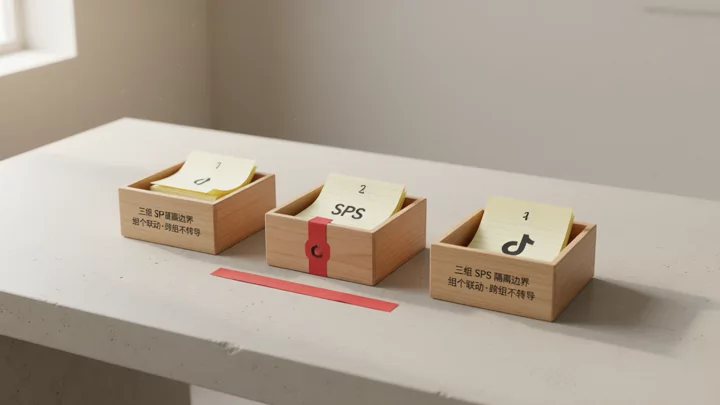
Key judgment point: Under the same license, if you simultaneously hold 2 cross-border stores + 3 Thai local stores + 2 Vietnamese local stores, the cross-border stores follow the China entity chain, and each local store must correspond to its respective local entity. With mixed holdings of 7 stores, the registration entity layer has already forked into three groups: "China×1 + Thailand×1 + Vietnam×1". A second-review rejection in any one group triggers SPS linkage within that same group but does not propagate across groups—provided that payment and logistics entities are also isolated by group. Detailed registration thresholds and second-review differences can be found inRegistration thresholds and second-review differences for the number of TikTok Shops that can be opened under one business license.
Why local store second reviews get stuck more easily than cross-border stores: Breakdown points in the three-tier entity chain
The same document combination that allows a cross-border store to pass review in one go under a single business license frequently stalls at the second review for Southeast Asian local stores. The root cause is not "filling in a few extra fields" but that the three-tier chain of registration entity, payment entity, and logistics entity is entirely different. Cross-border stores follow a China entity + cross-border logistics + USD/CNY payment path, with all three layers naturally aligned; local stores require a local entity or authorization + local logistics + local currency payment, and any single-layer misalignment triggers a rejection citing "documentation review not passed" or "legal entity verification mismatch".

High-frequency rejection reasons concentrate in three areas: First, passport or local ID card validity of less than 6 months causes the system to automatically flag a "legal entity verification" failure; second, the payment account name does not match the registration entity name (e.g., using a group parent company account to receive payments for a sub-brand's local store); third, the logistics agreement entity does not match the store's registration entity, triggering a "false shipment" risk flag. Troubleshooting paths can be found inItem-by-item comparison of cross-border stores and local stores on document review, second-review trigger reasons, and legal entity verification, of which the three-layer chain-break illustration and resubmission checklist can be directly applied to Thailand, Vietnam, and Malaysia.
10-Store Monthly Cost P&L: Cross-Border Flat Deployment vs. Local Store Matrix — Where the Money Actually Goes
Splitting the 10 stores into two scenarios — “cross-border flat deployment” and “Thailand–Vietnam–Malaysia three-group local store matrix” — reveals a starkly different distribution of fixed and variable costs. In the cross-border scenario, per-shipment logistics and cross-border payment channels are the main expenses; in the local store matrix scenario, the proportion of local license maintenance, local logistics contracts, and influencer commission fees rises significantly. The bar chart below displays the relative index across 6 cost dimensions (illustrative metrics, not actual statistics, for structural comparison only):
The cost inflection point typically emerges at the 5th–7th store: once cross-border stores scale to 7, per-shipment logistics costs begin to rise nonlinearly (cross-border delivery windows and package loss rates), and when the local store matrix reaches 7, annual license renewals and multi-country payment channel maintenance fees come due in a concentrated wave. If a team is scaling from 3 stores to 10, it is recommended to first complete the three-group structure for Thailand, Vietnam, and Malaysia before adding a 3rd Vietnam store, to prevent the three-tier entity architecture from fracturing again at the 10-store scale. For the complete grouping architecture and infrastructure configuration, refer toBuilding and Cost Breakdown of the Southeast Asia Local Store Matrix.
SPS Cascade After Grouping: Transmission Boundaries of Second-Review Rejections
TikTok Shop's SPS (Seller Performance Score) is scored independently per store, but multiple stores under the same registered entity share a 'same-entity violation penalty' mechanism: if one store is penalized in SPS for logistics violations or false shipping, the remaining stores under the same entity trigger a synchronous score reduction within a 24–72 hour window. Under the three-group × store-type × entity three-dimensional grouping, the score isolation boundaries are as follows: the Thailand group's 3 stores share the same Thailand local entity, the Vietnam group's 3 stores share the same Vietnam entity, the Malaysia group's 2 stores share the same Malaysia entity; and the cross-border group's 2 stores operate under a Chinese entity. SPS cascading within a group is inevitable, but it does not transmit across groups — this is the underlying mechanism behind the earlier conclusion that 'in a 7-store matrix, a second-review rejection in any one group only triggers a score reduction within that same group.' Account setup and asset ownership for TikTok Ads accounts are recommended to be managed throughthe official role and permission system of TikTok Business Centerby group separately, to avoid mixing Thailand, Vietnam, and Malaysia ad accounts under a single Business Center, which can cause cascading restrictions. For specific steps on multi-store environment configuration and sub-account permissions, refer toMulti-Store Grouping and Sub-Account Configuration for Managing 10 TikTok Shop Store Clusters from a Single Computer.
FAQ
Can payment accounts for local stores and withdrawal channels for cross-border stores be mixed?
No. Local stores must receive payments in the local currency (Thai Baht / Vietnamese Dong / Malaysian Ringgit), while cross-border stores use USD or CNY channels. Mixing them will cause the receiving entity to be inconsistent with the registered entity, directly triggering a "Legal Entity Verification" rejection during the second review. For a 10-store scale, it is recommended to set up independent payment channels by group; the annual fee differences are already reflected in the "Payment Channel Annual Fee" line item of the cost P&L.
What documents are required for resubmission after a local store is rejected in the second review?
Verify each item against the three-layer chain: registered entity certificates (local company or authorized representative documents), receiving entity (the account name must match the registered entity), and logistics entity (the contracting party of the agreement must be the store's registered entity). The most frequent bottlenecks are passports/ID cards with less than 6 months of validity and mismatched entities on logistics agreements. The troubleshooting path can be found in theSecond Review Rejection Troubleshooting Checklist, in which the three-layer chain breakdown diagrams and resubmission checklist can be directly applied to Thailand, Vietnam, and Malaysia.

